
Toolkit for Schools
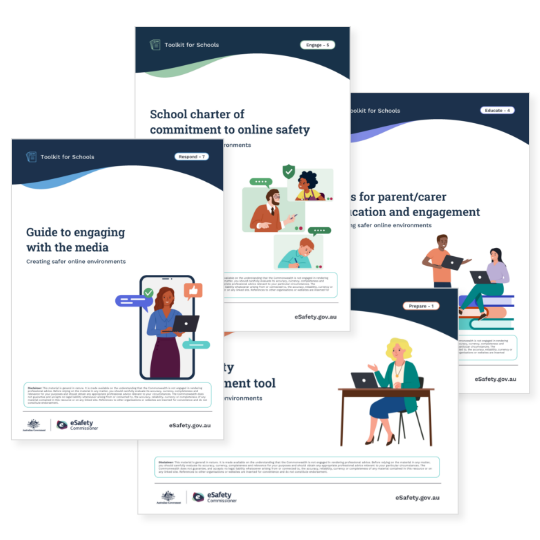
The eSafety Toolkit for Schools is designed to support schools to create safer online environments.
The resources are backed by evidence and support a nationally consistent approach to preventing and responding to online safety issues.
The resources are categorised into four elements: Prepare, Engage, Educate and Respond. Whether the resources from each element are used on their own or collectively, each contributes to creating safer online environments for school communities.
The Toolkit is flexible in its design so that schools can tailor how they use it, based on the needs of their community. This means that no matter which school a student attends, or what stage the school is at in its online safety journey, they will have the tools to help keep safe online.
eSafety developed the Toolkit in consultation with government and non-government education sector representatives across every state and territory. It was developed in response to the Royal Commission into Institutional Responses to Child Sexual Abuse and the Education Council’s work program to address bullying and cyberbullying.
The Toolkit should be used in conjunction with eSafety’s Best Practice Framework for Online Safety Education, which establishes a consistent national approach to delivering high quality programs with clearly defined elements and effective practices. The Framework’s implementation guide helps school leaders, educators and program providers use the Framework to design, deliver and review online safety education. It includes relevant links to the Toolkit for Schools, eSafety's classroom resources, the Australian curriculum, and existing policies and frameworks.
Download all the Toolkit for Schools resources by clicking on the 'Download all resources' button, or visit the Prepare, Engage, Educate and Respond pages to download resources individually.
Elements


A message from the eSafety Commissioner
Toolkit for Schools
Social media changes
- As of 10 December 2025, Facebook, Instagram, Kick, Reddit, Snapchat, Threads, TikTok, Twitch, X and YouTube are required to take reasonable steps to prevent Australians under 16 from having accounts on their platforms. See the latest list.
- Under-16s are still allowed to see publicly available social media content that doesn’t require logging into an account.
- Schools may need to explore alternative methods for communicating with parents and students.
- There are exclusions for a number of platforms, including educational tools such as learning management systems. For example, Google Classroom will not be age restricted.
- YouTube videos that can be seen without logging into an account can still be shared by teachers.
- For further guidance, including whether educators will be able to use their own accounts to share age-appropriate education materials, please refer to school or education sector policies and procedures.
Find out more at eSafety’s What do the social media age restrictions mean for educators.
Last updated: 09/03/2026