

Let's talk about being safe online
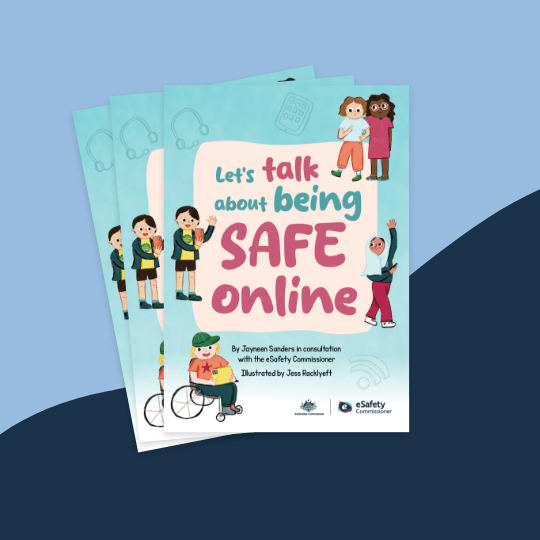
Read our online family book together. It’s designed to help children from age 7 explore online safety through simple, open conversations.
Every child has different levels of online experience, so it’s important to support them in having safe and positive interactions, wherever they’re at in their journey. You can read 'Let’s talk about being safe online’ or download it. You can also read along to the video version.
On this page:
- Read the story
- Watch the video
- My Safety Network activity
- Get your free copy of the book
- More resources
‘Let’s talk about being safe online’ teaches essential skills to help children stay safe, such as understanding consent, sharing responsibly, protecting personal information and recognising unsafe situations.
Educating children and families about online safety is a vital step in preventing online harms including child sexual abuse. This book is a practical and helpful tool to support you to have those important conversations at home.
To turn the pages, click or tap on the arrows next to the page numbers.
To view the book in full screen, hover your cursor over the top right corner of any page, click or tap on the dots, then click or tap on the screen button.
To share the book , hover your cursor over the top right corner of any page, click or tap on the dots, then click or tap on the share icon (with side arrow) and select from the social media options or copy the link.
To download the book, click or tap on the following file link, then in the top right corner, click or tap on the download icon (with down arrow):
Watch the video
eSafety collaborated with author, Jayneen Sanders, to develop this book. Jayneen is an experienced teacher, author, and mother of three. She is a passionate advocate for respectful relationships, gender equality and personal body safety education. Illustrations for the book are by Jess Racklyeft.
Watch Jayneen read the book and bring its important messages to life.
| Audio |
|---|
'Let's talk about being safe online' written by me, Jayneen Sanders, in consultation with the E-Safety Commissioner and illustrated by Jess Racklyeft. |
Hi, I'm Charlie and these are my friends online and offline. |
Every day my friends and I use phones and devices |
Being online can help me feel close to my family, friends and community, find important information, share my ideas and what matters to me. Devices and apps should be built to protect you from messages, pitches or people online that may hurt you. |
They should also be fun, perfect for your age |
We have private spaces in our homes like the |
A lot of the time we feel happy |
In this book you will learn how to keep yourself |
Using technology safely. |
Your safety network is three to five safe and |
These adults will listen to you and believe you. |
They could be a teacher, |
So up here we have the kids helpline number. |
Who is in your safety network? And this is Charlie's safety network. |
Here are some important online safety skills you |
This means the information you share is safe and |
Talk with your trusted adults about what picture |
You can check the location settings on your |
Expect respect and be respectful. |
For example, no one has to post things about |
Consent means asking if |
If someone wants to share a photo or video of you |
Even if you gave permission before, |
Safer and unsafe situations online. |
Early warning signs. |
These kinds of feelings are |
Here are some of the early warning
|
Talk to an adult in your safety network.
|
For example, if you feel unsure, |
Someone you are chatting to |
Someone asks you to send |
Here are some more important things you need to Safer online. |
Talk to your trusted adults about
|
Tell a trusted adult if you see a video or photo |
Unsafe online. |
Going into a private chat or sharing your |
Watching things online that make you feel |
Let's help Lee manage a |
Then one of his new friends asks him to chat privately so he can share a special thing from the game. This friend asks him to keep the private chat a secret. How might Lee feel? What can Lee do? When someone online asks you to keep a secret, tell a trusted adult in your safety network as soon as you can. |
Sometimes when you are online something worrying might happen, but you might feel afraid that you will get into trouble if you tell your parent or carer. For example, you may have been using your device at a time when you weren't supposed to be and you are worried your device will be taken away. |
If an adult in your safety network can't or won't help you, it's important to keep talking to one of the other trusted adults in your safety network for help. Some things that can help you deal with the tricky situation are: Ignore the person or block their account. Tell the person to stop contacting you. Kids deserve to be safe. It's never your fault when bad things happen online. |
Consent and sharing safely online. Remember, even if you're chatting online in your living room or bedroom, the online world is not private and things can be shared more than you expect. Sometimes when you're playing games or chatting online, sharing with a friend can be fun. Before you share or post things online, it's always a good idea to think about the grandma or teacher test. This means asking yourself, "Would I be happy if my grandma or teacher saw this text, photo or video?" If the answer is no, then don't share. |
Personal information like your address and school should always be kept private. Personal information like your birthday, This means being careful when sharing photos that show where you live or your school uniform. |
Asking before taking photos and videos of others. People should ask for your consent before sharing anything about you. So, it's okay to say no. |
Keeping safe around photos and videos. No one should ever ask you for private photos or share their private photos with you. They also shouldn't pressure you to do things you don't want to do in a video call or chat, or ask you to do anything that makes you feel uncomfortable and unsafe. For example, for some people, their head or their legs might be a private part of their body. |
These might feel private because of your culture or maybe you prefer these parts of your body to be private. What if something gets shared about you? Sometimes when we share things online, these things can be shared more |
Also, your picture could be changed around to look really different from the one you shared with them. Do you think it is okay for people to share things without your consent? If something does happen without your consent, the most important thing is to |
Tricky content. Sometimes friends, siblings or even adults can share things that kids shouldn't see. This might be done accidentally or on purpose. Maybe someone sent you pictures of people's private parts on purpose. Or maybe an unsafe ad popped up on your screen by accident. |
Remember, you don't have to look at or do anything that upsets you or makes you feel unsure, uncomfortable or unsafe. You don't have to carryall your worries by yourself. Remember, if a mistake has been made or something unsafe has happened, |
Speaking up is brave and the best thing to do. Remember, your online adventures should be fun and feel comfortable. If something happens online that worries you, you should talk to your trusted adult. Have fun online and explore safely. |
Let's Talk About Being Safe Online
| Audio |
|---|
'Let's talk about being safe online' written by me, Jayneen Sanders, in consultation with the E-Safety Commissioner and illustrated by Jess Racklyeft. |
Hi, I'm Charlie and these are my friends online and offline. I'm Lee, I'm Kira, I'm Darcy and I'm Nour. We can do some amazing things online. |
Every day my friends and I use phones and devices to talk to our families and each other. We play fun games, watch cool videos together, learn new stuff and even stay strong and healthy. |
Being online can help me feel close to my family, friends and community, find important information, share my ideas and what matters to me. Devices and apps should be built to protect you from messages, pitches or people online that may hurt you. |
They should also be fun, perfect for your age and keep your information private. Private means just for you. |
We have private spaces in our homes like the bathroom and your bedroom. In the online space, private information means information about you that you don't share with others. For example, where you live. |
A lot of the time we feel happy and safe to explore what's online. But being online can be tricky sometimes too and not everyone online is friendly and kind. In this book you will learn how to keep yourself safer online and know how to get help if something worries you. |
Using technology safely. Okay, on the next pages we will look at things you can do to have fun online and stay safe. Before you start, choose a safety network. |
Your safety network is three to five safe and trusted adults who you can talk to whenever you feel worried or unsafe, online or offline. These adults will listen to you and believe you. They will do their best to help you. Make sure that at least one of these adults is someone who is not in your family. |
They could be a teacher, a coach or a kids helpline counsellor. Your safety network might change over time as well and that's okay. |
So up here we have the kids helpline number. So who will be on your safety network? Remember it is always your choice. |
Who is in your safety network? And this is Charlie's safety network. |
Here are some important online safety skills you need before you get started. Set up your games or apps for safety. When you set up a new app or game with one of your trusted adults, make sure you set your profile to private. |
This means the information you share is safe and that people you don't know will not be able to contact you online. Talk with your trusted adults about what picture is appropriate to use for your profile. |
You can check the location settings on your device and apps with a trusted adult. Sometimes sharing your location can show people where you live or where you go, so it's important to be careful. |
Expect respect and be respectful. Respect means being friendly, kind and taking care with other people's feelings. It also means respecting other people's rights to keep things about themselves private. |
For example, no one has to post things about themselves or have their pictures or video shared without their consent. Consent means asking if something is okay or not okay. It means one person asks for permission and the other person gives permission or not. |
If someone wants to share a photo or video of you and you don't want them to, you have the right to say no and then tell a trusted adult on your safety network what happened. Even if you gave permission before, you can always change your mind. |
Safer and unsafe situations online. After you have set up your device, apps and games with your trusted adult, there are some more important things for you to know.
|
Early warning signs. Sometimes your body might give you a clue that something online isn't quite right. Like feeling sick in your tummy or feeling shaky all over. |
These kinds of feelings are called your early warning signs. When you feel uncomfortable or unsafe, you might get just one of your early warning signs or you might get many. Here are some of the early warning signs you may get if you feel unsafe. A sweaty brow, goose bumps, shaky all over, sweaty palms, needing to go to the toilet, hair feeling like it's standing on end, starting to cry, heart beating fast, feeling sick in the tummy, wobbly legs.
|
Talk to an adult in your safety network. Sometimes you might feel excited at first or confused about what is happening. If you ever feel any of your early warning signs, you should get help from a trusted adult in your safety network as soon as you can. |
For example, if you feel unsure, uncomfortable or unsafe online, you receive messages that make you feel uncomfortable. Someone you are chatting to online seems gross, weird or sus, or doesn't seem to be telling the truth. Someone asks you to send pictures or videos of yourself. Someone contacts you online and you don't know them. |
Here are some more important things you need to know about being safer and unsafe online. Safer online. Play games, watch videos or have video calls without headphones on in shared spaces, such as the kitchen or the lounge room. Talk to your trusted adults about who you chat, game or message with. Only play games that are designed for kids your age. These are made especially for you. Tell a trusted adult if you see a video or photo or hear a message that makes you feel uncomfortable or unsafe, or if anyone invites you to a place online you haven't been before. |
Unsafe online. Someone asking you to keep a secret about things that happen online, or asking you to keep a chat or gift a secret. Staying in a game chat where other players are saying rude, mean or inappropriate things to you or others. Going into a private chat or sharing your personal information with someone you first met online. Someone sending private pictures or asking you to do the same. Being made to feel scared, embarrassed or pressured to do things online that don't feel okay. |
Watching things online that make you feel confused, sad, worried or scared. What should you do if someone asks you to keep a secret online? How to keep safe in tricky situations. Let's help Lee manage a tricky online safety situation. |
Lee has made some new friends in a game. He feels good because they all enjoy playing the game together and they sometimes cheer him up if he's having a bad day. Then one of his new friends asks him to chat privately so he can share a special thing from the game. This friend asks him to keep the private chat a secret. How might Lee feel? What can Lee do? |
When someone online asks you to keep a secret, tell a trusted adult in your safety network as soon as you can. You can say, "something happened online that made me feel scared, excited, angry, nervous, unsure." Sometimes when you are online something worrying might happen, but you might feel afraid that you will get into trouble if you tell your parent or carer. For example, you may have been using your device at a time when you weren't supposed to be and you are worried your device will be taken away. Even if you think you may get into trouble, the safest thing to do is to go to a trusted adult straight away. They will help you manage the tricky situation. |
If an adult in your safety network can't or won't help you, it's important to keep talking to one of the other trusted adults in your safety network for help. Some things that can help you deal with the tricky situation are: Ignore the person or block their account. Tell the person to stop contacting you. Kids deserve to be safe. It's never your fault when bad things happen online. |
Consent and sharing safely online. Remember, even if you're chatting online in your living room or bedroom, the online world is not private and things can be shared more than you expect. Sometimes when you're playing games or chatting online, sharing with a friend can be fun. Before you share or post things online, it's always a good idea to think about the grandma or teacher test. This means asking yourself, "Would I be happy if my grandma or teacher saw this text, photo or video?" If the answer is no, then don't share. Talk with your trusted adults about what is okay to share about yourself online. For example, you might agree that you can share posts and videos of yourself privately with your family, but you can't post these online. |
Personal information like your address and school should always be kept private. Personal information like your birthday, phone number, where you live and where you go to school is private. This means being careful when sharing photos that show where you live or your school uniform. When you're gaming or having a video chat, you can add or blur your background to prevent anyone seeing your location. |
Asking before taking photos and videos of others. People should ask for your consent before sharing anything about you. Even family members. This can include people sharing personal information or pictures of you online. You have the right to say yes or no to people sharing photos or videos of you online. When someone takes a picture without asking, it can feel like they have invaded your personal space. So, it's okay to say no. |
Keeping safe around photos and videos. No one should ever ask you for private photos or share their private photos with you. They also shouldn't pressure you to do things you don't want to do in a video call or chat, or ask you to do anything that makes you feel uncomfortable and unsafe. Your body is private and it belongs to you. Your private parts are the parts of your body under your bathing suit. Other parts of your body might be private as well. For example, for some people, their head or their legs might be a private part of their body. |
These might feel private because of your culture or maybe you prefer these parts of your body to be private. What if something gets shared about you? Sometimes when we share things online, these things can be shared more widely than you might expect. For example, if you post a picture in a private chat with your best friend, they might share it with their family and friends. Or they could even repost it on a website without asking for your consent. Also, your picture could be changed around to look really different from the one you shared with them. Do you think it is okay for people to share things without your consent? If something does happen without your consent, the most important thing is to get help from your trusted adult. |
Tricky content. Don't forget, the internet can be a fun place, but not everything online is safe for kids. When you are online, you might see photos or videos that make you feel anxious, unsafe or uncomfortable. Sometimes friends, siblings or even adults can share things that kids shouldn't see. This might be done accidentally or on purpose. Maybe someone sent you pictures of people's private parts on purpose. Or maybe an unsafe ad popped up on your screen by accident. Remember, if you see pictures or videos that aren't safe for kids, you don't have to deal with it on your own. As soon as you can, go to one of your trusted adults and talk to them about what you saw. Even if you feel embarrassed, remember it's not your fault and you didn't do anything wrong. |
Remember, you don't have to look at or do anything that upsets you or makes you feel unsure, uncomfortable or unsafe. Even if someone tries to show you something you don't want to see, you do not have to look at it. Remember, your trusted adults are there for you. You can talk to them about anything and they will listen to you and help you. You don't have to carryall your worries by yourself. Remember, if a mistake has been made or something unsafe has happened, please tell your trusted adult. |
Speaking up is brave and the best thing to do. Remember, your online adventures should be fun and feel comfortable. If something happens online that worries you, you should talk to your trusted adult. Have fun online and explore safely. |
Let's Talk About Being Safe Online - Auslan reading
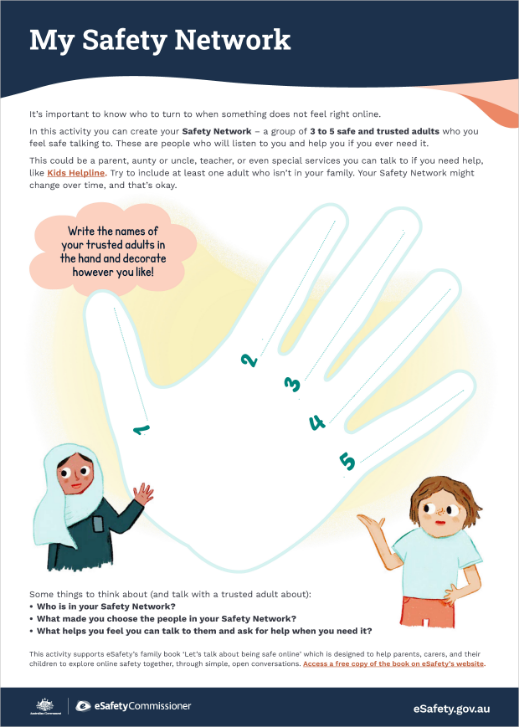
My Safety Network activity
In this activity, children can create their Safety Network – a group of 3 to 5 safe and trusted adults who they feel safe talking to. These are people who can listen and help, and could be a parent, aunty or uncle, teacher, or even special services, like Kids Helpline.
This activity is referenced in ‘Let’s talk about being safe online’ and is a useful tool for children, parents and carers to help think and talk about online safety together.
Download
Get your free copy of the book
Free of charge to Australian residents. Click the button below then give us your details on the email, so we can send you a copy of ‘Let’s talk about being safe online'.
More resources
For children under 7, eSafety’s Swoosh, Glide and Rule Number 5 being safe online picture book is available to read and download for free.
Tips for talking with older children and young people about what they see online in our hard-to-have conversations.
eSafety has also developed advice to help you understand what online behaviours to expect at different ages and how to have suitable conversations about online risks, such as sexual abuse.
Last updated: 20/10/2026