

How common are experiences of seeing online hate among children in Australia?
In late 2024 and early 2025, prior to the implementation of the social media age restrictions1, eSafety surveyed 2,302 Australian children aged 10 to 17 years2 to determine the prevalence and nature of online experiences and harms, including seeing online hate.3
Here are some of the key findings.
Children from certain groups are more likely to have seen online hate

88%
of trans and gender-diverse children had seen online hate.6
(75% had seen online hate in the past 12 months.)

85%
of sexually diverse teens had seen online hate.7
(73% had seen online hate in the past 12 months.)

74%
of Aboriginal and/or Torres Strait Islander children had seen online hate.
(65% had seen online hate in the past 12 months.)

68%
of children with disability had seen online hate.
(57% had seen online hate in the past 12 months.)
A similar proportion of girls and boys have seen online hate

Around 3 in 5
girls (60%) and boys (58%) had seen online hate at some point.
(48% of girls and 46% of boys had seen online hate in the past 12 months.)
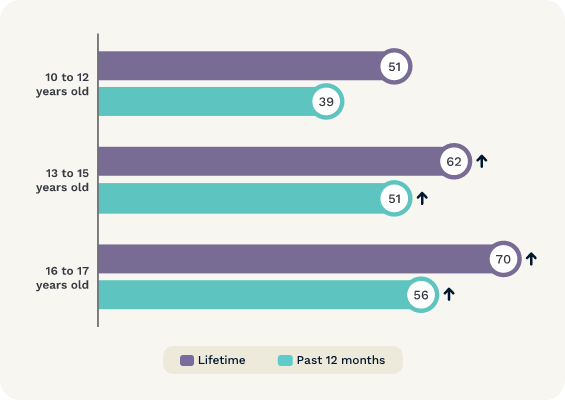
Exposure to online hate increases with age
Graph shows prevalence of exposure to online hate by child age.8
|
Children see diverse forms of online hate

39%
had seen online hate against people with a specific skin colour, race or culture at some point.
(28% in the past 12 months.)
38%
had seen online hate against people who are gay, lesbian, bisexual or any other sexuality that isn’t straight or heterosexual.
(28% in the past 12 months.)
38%
had seen online hate against people who are transgender, non-binary or gender diverse.
(28% in the past 12 months.)
37%
had seen online hate against people from a specific country.
(26% in the past 12 months.)
36%
had seen online hate against people with specific religious beliefs.
(26% in the past 12 months.)
35%
had seen online hate against women or girls.
(24% in the past 12 months.)
30%
had seen online hate against people with a disability or diagnosis.
(21% in the past 12 months.)
25%
had seen online hate against Aboriginal or Torres Strait Islander people.
(16% in the past 12 months.)
24%
had seen online hate against men or boys.
(16% in the past 12 months.)
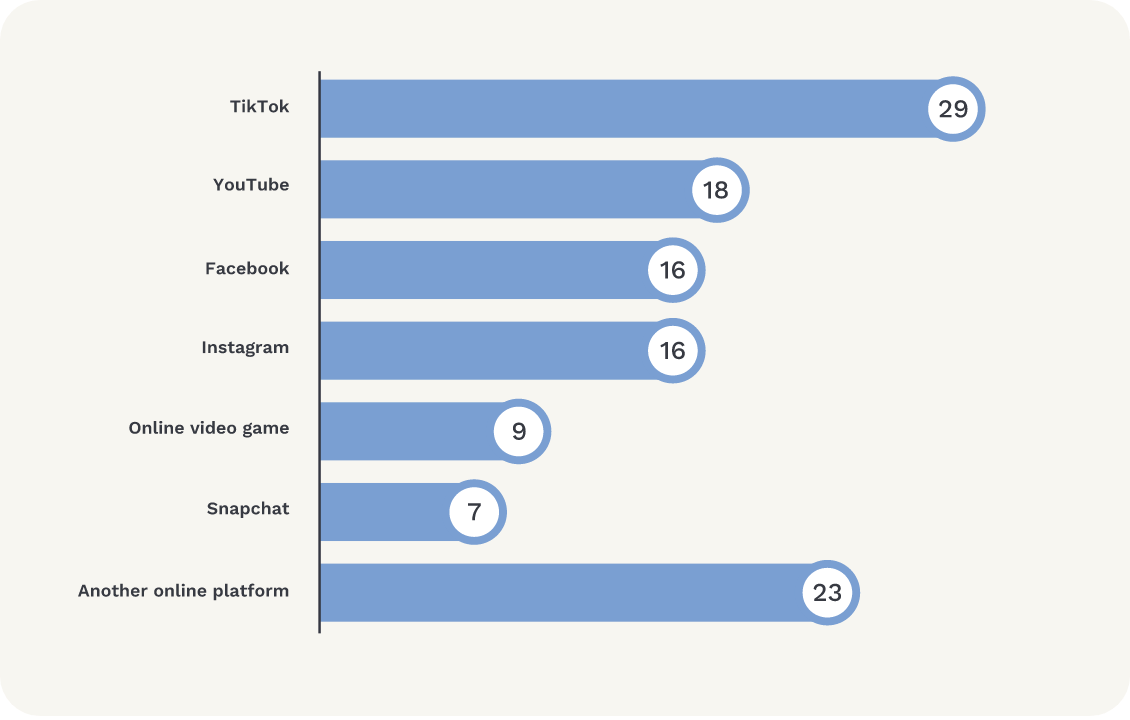
Children typically see online hate on social media
Children's most recent experiences of seeing online hate9 typically occurred on social media platforms10, such as TikTok (29%), YouTube (18%), Facebook (16%) and Instagram (16%).11
|
Helpful resources
eSafety’s Parents section has information for parents and carers, including information and advice about helping children stay safe online.
eSafety’s Kids and Young People sections provide useful information to help children and teens stay safe online.
Notes
1 Under the legislation, which came into effect on 10 December 2025, age-restricted social media platforms must take reasonable steps to prevent Australian children under 16 from creating or holding accounts.
2 Part of a nationally representative survey of 3,454 children aged 10 to 17 years living in Australia between December 2024 and February 2025.
3 For more information about the methodology of the research, see the methodology report.
4 Q: Have you ever seen anyone say or post offensive or threatening things online, to or about people, because they were hateful of …? Important: Don’t include things you have seen in TV shows or movies, like on Netflix or Disney+. You can include things that were said or posted as ‘just a joke’.
5 Prevalence of experiences of seeing online hate was assessed in a recontact survey (n=2,302).
6 The smaller sample size for trans and gender-diverse children should be considered when interpreting these findings (n=58).
7 Sexually diverse’ includes participants who identified their sexual orientation as 'gay or lesbian’, ‘bisexual’, ‘queer’, ‘asexual’, ‘pansexual’ or that they are ‘still working it out’. Sexuality was asked only of children aged 13–17.
8 Arrows denote statistically significant differences between sub-groups. The proportion of children aged 13 to 15 and 16 to 17 who had seen online hate in the past 12 months didn’t differ significantly.
9 A subset of children who had seen online hate (n=781) were asked further questions about their most recent or impactful experience of this.
10 Q: Think only about the last time you saw someone say or post offensive or threatening things to or about others online because they were hateful of [RECENT EXPERIENCE]. Which platform did you see it on?
11 Platforms reported by <5% of children combined as ‘Another online platform’.
Last updated: 16/06/2026