

Social media age restrictions: Get-ready guide for under-16s
As of 10 December 2025, many social media platforms aren't allowed to let Australians under 16 have an account. This is to protect you from design features that encourage you to spend too much time online and show you content that can be harmful to your health and wellbeing.
If you're underage and still on social media, you could have your account removed or deactivated at any time until you turn 16 - even if you've already passed an age check. It's a big change - and you may be worried about losing access to your favourite people, content and communities. But there are other ways you can stay connected, express yourself, find out about things and have fun.
This 8-step guide will help you work through what you can do to adjust.
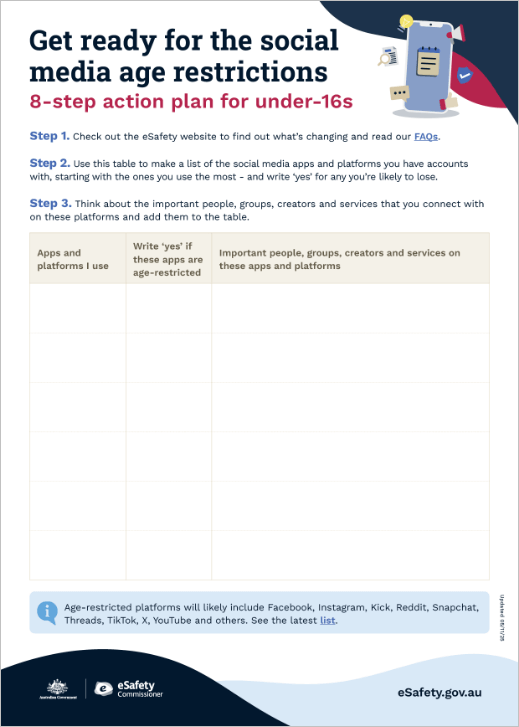
You can download or print the action plan at the end of this page, then fill it in to keep track of your progress.
Understand what’s changed and why
Find out what the change means for you:
- Check our frequently asked questions page for young people for the latest updates.
- Talk about what this all means with friends and family.
- Ask questions of trusted adults - you can show them eSafety's hub if they need more info.
Work out which accounts you could still lose
Create a list of all the accounts you have with apps and platforms that are affected by the new social media rules. These include:
Others may be added – it all depends on the platform’s features. Find the latest list.
To be on the safe side, it’s a good idea to follow the steps on this page for all your apps and platforms, starting with the ones you use the most.
Map your digital world
Think about what you do on these platforms and who you connect with – you can do this on your own or with friends or family. Here are some questions you can ask yourself:
- Which chats, groups, creators and influencers are most important to me?
- What digital spaces and communities do I belong to?
- What sources of news and information might I lose?
- What support services do I access via social media?
Remember, you can still access publicly available content that doesn't require logging into an account.
Explore other ways to connect and belong
Make a list of the friends and family members you usually connect with on any platforms that are affected by the age restrictions. Talk with them about other ways you can stay in touch. Here are some ideas:
- Make plans to catch up in person and explore offline activities – see our tips for balancing your time online for suggestions.
- Ask close contacts for their phone number if you don’t already know it. But never share phone numbers or other sensitive personal information in public posts or with anyone you don't know in person - find out more about protecting your identity.
- Ask for their gamertag or profile name on any other apps or platforms they use.
- Schedule regular phone catch-ups, or stay in touch through an age-appropriate online chat or video app or by email.
- Move group chats onto messaging apps that are not age-restricted.
- Find other age-appropriate apps with the features you and your friends enjoy.
- Remember, even platforms that are not age-restricted can have risks:
- Look through eSafety's pages for young people to find out about common issues like cyberbullying and threats to share nudes.
- Check The eSafety Guide for advice on how to protect your personal information and report harmful content on platforms, games, apps and sites.
- Bookmark I need help for information and guidance on what you can do if things go wrong online.
Build your community
Look into alternative ways to find like-minded people, explore your interests and follow supportive content creators and online communities:
- Make a note of your favourite influencers, streamers and celebrities (their account names/handles/gamertags) so you can look them up via a web browser.
- Find out whether they’re active on other age-appropriate channels such as a blog, podcast or newsletter.
- Research alternative sources of news, information and inspiration.
- Think about the communities you’re part of on social media and how else you can access them - visit their websites to find out.
- If you have relied on social media for support, check where and how you can get similar help. For example, My Circle is a free, private, safe and confidential social network for 12- to 25-year-olds, supported by Kids Helpline counsellors. You can also explore these ReachOut pages that have lists of national, state and territory-based services and ways to connect:
- Support services for Aboriginal and Torres Strait Islander people
- Ways to connect with community if you're a First Nations young person
- Yarn up - a space where young First Nations people access wellbeing resources and support.
- Support services for culturally and linguistically diverse young people
- Culturally diverse LGBTQIA+ support services and groups
- LGBTQIA+ support services.
Protect your digital memories
Age-restricted platforms should tell you what will happen to your accounts and how you can save your data and content - some may have already been in touch, while others may take longer. How this works depends on the platform, so if your account is still active don't assume it will stay that way. Save any precious material now, if you haven't already:
- Take screenshots or download your favourite posts, chats, photos or videos (the platforms should provide instructions on how to do this, or you can check The eSafety Guide for help).
- Save them in a folder on a device or hard drive like a laptop or USB, or in cloud storage (a parent or carer may give you access to a shared drive for this).
- Don't delay - the new rules are in effect so finish downloads and backups now if you haven't already.
- Visit the platform’s ‘Help’ or ‘Support’ section if you’re unsure what will happen to your account data and content.
Avoid last-minute stress
Start taking action now. If you still have an account, it could be removed or deactivated at any time until you turn 16. You can manage this change with less stress and hassle by taking steps to adjust.
- Wind back your social media use rather than waiting for the platforms to suddenly close your account. For example, you could reduce screen time in your settings.
- Start muting notifications and unfollowing accounts so you don't have a hard stop.
- Download alternative apps, adding trusted contacts and creating new groups and chats, so you can keep connecting with friends, family and communities.
Find support
Reach out for help and support at any time. This is a big change. It will take time to adjust but you don’t need to deal with it on your own:
- Talk to a trusted adult in your life who you feel safe confiding in about difficult things - it could be someone like a parent, teacher, older sibling or cousin.
- If you don't have anyone close you can talk with, you can contact Kids Helpline (for 5- to 25-year-olds), eheadspace (for 12- to 25-year-olds), Beyond Blue (for all ages) or another free or confidential counselling or support service.
- Go on the forum set up by Beyond Blue for young people, where you can safely discuss how you're feeling about the social media age restrictions.
- Check out these ReachOut resources:
- What to do when you're feeling lonely - 11 helpful tips
- Ask a therapist: What to do if you're feeling lonely
- How to cope when things are out of control
- 7 tips for dealing with change.
It's important to remember that no matter how old you are, if you have a harmful experience online you should reach out for support - even if you're under 16 and it happens on social media.
- Depending on what has happened, there are different ways to get support from eSafety or other services. You won't get into trouble.
- Visit eSafety's I need help page for young people for information and guidance on what to do about cyberbullying, threats to share nudes and other issues online.
- If you're nervous about reporting to eSafety, you can speak first with a free, confidential support service like Kids Helpline (for 5- to 25-year-olds), eheadspace (for 12- to 25-year-olds) or Beyond Blue (for all ages), or choose another counselling or support service.
Save your personal action plan
To help you manage the change, download or print the 8-step action plan and fill it in - you may like to work on it with your friends and family so they can adjust too.
About this page
The information on this page was written in consultation with Beyond Blue, Headspace, Kids Helpline, Raising Children Network, ReachOut and eSafety's Youth Council.
Last updated: 03/02/2026
 Get connected with eSafety