

How to talk about social media age restrictions with under-16s
The conversation starters on this page will help parents, carers and young people talk together about social media law changes in Australia and the impacts.
If your child is under 16, age-restricted social media platforms are not allowed to let them have accounts from 10 December 2025. This is to protect under-16s from design features that encourage them to spend too much time online, and over-expose them to negative, upsetting and manipulative content. These features have been linked to harms to health and wellbeing.
Starting conversations about social media and the age restrictions can feel daunting, especially if the young people in your life find the changes difficult to understand and accept. The examples on this page can help get the discussion about the age restrictions, online safety and wellbeing going.
On this page:
How to use the conversation starters
We understand families and households have their own agreements and approaches to being online and using devices, and that every child is different. If you’re caring for children of varying ages you may need to talk with them in different ways. You can adapt the topics to suit your family.
You know your children best. Keep in mind your child’s age, developmental stage, emotional readiness and individual needs when deciding what to say. You can pick and choose between the conversation starters to create a safe space for your child to feel heard, supported and empowered.
- Find out about the social media changes – our frequently asked questions (FAQs) are a good place to start, and you can also check our Guide and action plan for helping under-16s understand the changes. Here are some fast facts:
– The age restrictions apply to Facebook, Instagram, Kick, Reddit, Snapchat, Threads, TikTok, Twitch, X and YouTube. See the latest list.
– There are no penalties for under-16s who access an age-restricted social media platform, or for their parents or carers.
– Even if your child is no longer using an age-restricted social media account they are likely to still be online and need guidance about safety, especially for using alternatives like groups chats on messaging apps. - If possible, first explore the platforms your child has been using so you can talk more confidently about the features, the types of experiences they may have been having and the things they may have seen. eSafety’s research into children’s online lives has helpful insights.
- Give your child an idea of what you want to talk about beforehand, so they have time to think. No one likes being put on the spot.
- Choose a place (and time) that’s relaxed and free from distractions – somewhere your child feels safe and comfortable. A walk or car ride can be a great time to chat because it feels less intense than when you’re looking directly at each other. If you have more than one child, think about whether it’s best to discuss the changes as a family or household, or to have individual conversations.
- Pause and check in with yourself: Am I feeling calm and settled? Am I prepared for a potentially tricky or emotional conversation? Do we have an understanding within our family about device use and social media, and how will that include staying off age-restricted platforms? Can I confidently explain our approach to my child and others, even when expectations are different in other households where they spend time?
- Ask open-ended questions and listen carefully to what your child has to say, leaving space for them to share their own thoughts in their own words – this shows you are genuinely curious about their opinions and care about their concerns.
- If your child needs help to express themselves, gently prompt them with some possible responses.
- Encourage them to ask their own questions – this allows your child to take the lead according to their own curiosity, concerns and needs.
- It’s okay not to have all the answers – honesty and openness go a long way to building trust. Reassure your child that any question is okay to ask and if you don't know the answer you will help them find out. You can even search the answers together – starting with our social media age restrictions FAQs and resources for young people.
- If they don’t want to continue the conversation, it’s important you respect this. It’s okay to try again later if the chat hasn’t gone too well.
- Take time to reflect on how the conversation went and what may need to be explored further.
- If questions were raised that need more information, set aside some time to continue searching together. Or if you find out answers without them, use it as an opportunity to have another chat.
- Help your child to go through our Get-ready guide for under-16s and fill out their personal action plan to think about alternatives for staying connected. If they’ve already filled one out, this may be a good time to check that they’re on track with it.
- Follow up. Lots of little chats are often more effective than one big conversation and can help you both gradually understand and adjust to the changes.
- When your child is approaching 16, start talking with them about the social media accounts they may want to sign up for or return to using. Together you can explore what they need to do, as well as safety tips for using the accounts.
How we talk about children and families
Throughout eSafety’s website and resources we use ‘families’ and ‘parents and carers’ to talk about the adults who support children. When we use these terms, we include the mums, dads, parents, carers, aunties, uncles and other supportive adults who we know can have an important role in helping children play, learn and grow.
When we talk about ‘children’ we mean everyone under 18 years old. Sometimes we include the term ‘teens’ or ‘teenagers’ when we specifically mean older children. We also use ‘young people’ when the advice could apply beyond childhood and into their mid-20s.
Conversation starters
You can choose to follow these in order, moving from a general conversation about social media use to specific details about the changes. Or you can mix them up to suit your child's mood, interests and readiness. You know your child best, so use that knowledge to guide the conversation in a way that works for your family.
Click or tap + to expand.
Have a general chat about their social media experiences
Keep in mind that the restrictions aim to reduce pressure on young people, so chatting about their current experiences may be a natural way to lead into the topic. It can also help you understand what they may be concerned about missing out on. Here are some suggestions:
- ‘Hey, I’ve been thinking about how you use your devices lately...’
- ‘What do you enjoy most about them?’
- ‘What are your favourite apps right now?’
- ‘What do you spend most of your online time doing?’ Examples may include seeing friends' posts, following their interests, watching creators or making videos.
- ‘How do you feel when you’re scrolling or when you’re using [name of app]? Is it always the same?’ Examples may include feeling energised, relaxed, focused, stressed, not good enough or overwhelmed (this may change with the content).
- ‘Do you feel like you’re going to miss out if you’re not getting notifications or able to like or react to things?’
- ‘Where do you usually find out about news?
- ‘Where do you normally find out about wellbeing stuff?’
Ask what they’ve heard about the age restrictions for under-16s
There’s a lot of worry and misinformation around the changes, so these questions will help you work out how well they understand what's happening and give them some accurate information. Here are some suggestions:
- ‘Have you heard about the new age restrictions? I don’t completely understand the changes, so we should probably find out about them.’
- ‘I know social media was a big part of how you connected and shared with friends. Have you spoken with them about under-16s no longer having account access? How do you all feel about it?’
- ‘Do you know if the apps you use will be affected by the social media age restrictions?’
- ‘I hear the social media restrictions for under-16s don’t apply to all online spaces – have you talked with your friends about the messaging apps and online games you can still use?’
- ‘Do you know why the law changed? I think it’s because of the way social media design features like notifications and disappearing content encourage everyone to spend more time on screens, and that can also mean seeing a lot of manipulative and upsetting content.’
- ‘I’ve been told the eSafety website has a lot of helpful information about the social media age restrictions. Want to check it together?’
Check how they feel about the change
Research by eSafety has shown that young people are feeling a range of emotions about the social media restrictions. Some are angry and disappointed. Others say they’re relieved because it will take a lot of pressure off and allow them to enjoy life more.
The main thing to focus on is that the changes are about protecting people their age, and that you will help them deal with the impacts. Try these suggestions:
- ‘It’s completely okay to feel upset or confused about under-16s no longer being allowed to have social media accounts. I’d feel the same if something I liked was suddenly off-limits. Let’s talk about why it’s happening.’
- 'I get that this change feels unfair and frustrating – and that's understandable. But there’s been a lot of concern about how social media can affect young people like you and your friends, especially the pressure to keep up. Can we chat about that?’
- ‘Researchers say the change will help protect young people from things that can be overwhelming or harmful. What do you think it’s about?’
- ‘I don’t like how social media can make me spend too much time comparing myself with other people and sometimes feel like I’m not good enough. Does it ever upset you like that? Do you think the restrictions could help?’
- ‘Some really violent videos get served up on social media. Have you ever felt upset or confused about things you’ve seen? What was it to do with? Researchers say the restrictions will hopefully help prevent that.’
Talk about scaling back social media and finding alternatives
This is about offering support for switching off social media accounts. Parents and carers can encourage their under-16s to make a gradual change, instead of experiencing the stress of a hard stop when the platform takes action.
It may help to follow eSafety’s Get-ready guide and action plan for parents and carers or get your child to look at the Get-ready guide for under-16s so you can talk about their own individual experiences.
Here are some ways to get started.
Begin to scale down use of age-restricted platforms together
- ‘How would you feel about us trying to use [app/platform] a little less each day, and seeing how it goes together?’
- ‘Would you like to check how much time we’re both spending on certain platforms, and maybe set a goal to reduce it bit by bit?’
- ‘Let’s look at the accounts we follow. Are there any you’d like to mute or unfollow now, to ease into switching off and avoid the stress of a hard stop?’
- ‘What do you think about turning off notifications at certain times, so we’re not tempted to check our phones as much?’
- ‘If you ever want to take a break from an app, I can help you log out or remove saved passwords to make it easier.’
Explore alternative ways to stay connected
- ‘Let’s work out a way together to stay in touch with your friends or groups you care about like [names], so it feels right for you.’
- ‘Have you and your friends talked about other ways to connect as a group? I know you like watching [creator]. We might need to see if we can find them, or someone like them with a similar interest, on another platform or on public feeds that are not age restricted.’
- ‘How about we chat with [friend’s name] parents and see how they’re feeling about the new law, so we can find ways for you to stay connected?’
- 'It's totally normal to want to stay connected with your friends. Let's work out other ways you can keep in touch and share your creativity. There are platforms that are designed for people your age.’
- ‘Even if you’re not using social media accounts there are still pressures and risks. Let’s work out some online safety strategies, like managing your privacy settings.’
Try showing you can make changes yourself
Children and young people learn by watching the adults around them, so modelling healthy digital habits can be a powerful tool for parents and carers to encourage under-16s to feel it’s okay not to have social media accounts. Are you up for the challenge?
Many adults use social media for connection and downtime, just like young people. We can be exposed to the same pressures – and also find it difficult to recognise when our use is becoming problematic and we need to set our own boundaries.
Exploring our own online habits and making changes can open more ways to talk with young people about the age restrictions, as well as about ongoing online safety and wellbeing issues.
Here are some examples.
- Talk about why you’re making a change. For example: ‘I’m trying to change how I use social media too. I’ve unfollowed some accounts that made me not feel too good, and I’m setting limits on how much time I spend scrolling online. It’ll help me feel happier and more balanced.’
- Admit that it’s hard to do. For example: ‘Sometimes I notice I reach for my phone when I’m tired or overwhelmed. It helps me switch off. But I’m also trying to be more mindful about when and why I jump into certain social media platforms. It’s not easy, but I’ve got to remember to take breaks and set limits when I feel that way.’
- Share your feelings about what makes you uncomfortable. For example: ‘Sometimes I see things online that make me upset, and I talk to a friend or take a break. It’s okay to feel that way, and it’s important to know when to step away.’
Let them know how to find help
Let your under-16s know it’s okay to reach out for help if they’re struggling with the social media change or any other issue.
It’s also important to reassure them that there’s always support available if something goes wrong online – their wellbeing is the most important thing, and they won’t get into trouble. There are no penalties for under-16s who access an age-restricted social media platform, or for their parents or carers.
Here are some questions you could use to help them map their support network.
- ‘Hey, you know you can always come to me if you need help, even if you think you’ve done something wrong? I won’t be angry with you. But if I’m not around, or you feel better speaking with someone else, who would you turn to for support?’
- ‘We can make a list of trusted people together – someone else in the family, or maybe there’s a teacher, wellbeing coordinator or counsellor. Do you know how to contact them? Where would you like to keep the list – maybe on your phone?’
- ‘I heard there are some free, confidential services listed on the eSafety website. What about looking at those and adding them to your action plan or bookmarking them?’
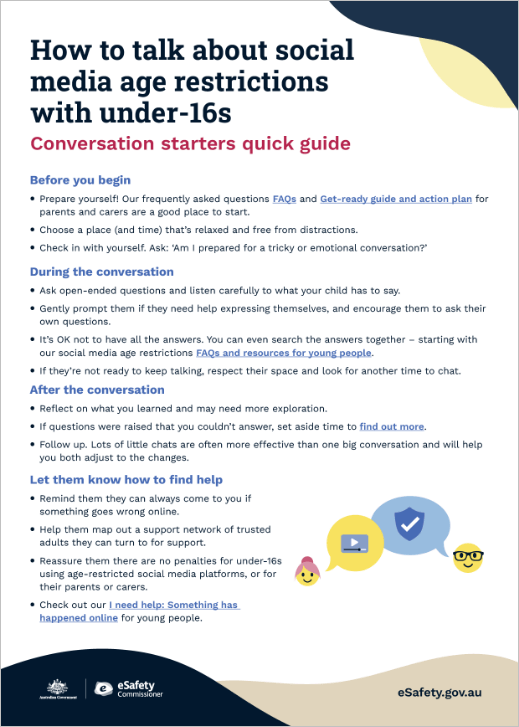
Download the conversation starters quick guide
Health and wellbeing advice
These organisations have resources for parents, carers and young people.

About this page
The information on this page was written in consultation with Beyond Blue, Headspace, Kids Helpline, Raising Children Network, ReachOut and eSafety's Youth Council.