

How common is cyberbullying among children in Australia?
In late 2024 and early 2025, prior to the implementation of the social media age restrictions1, eSafety surveyed 3,454 Australian children aged 10 to 17 years2 to determine the prevalence and nature of online experiences and harms, including cyberbullying.3
Here are some of the key findings.
Children from certain groups are more likely to be cyberbullied

81%
of trans and gender-diverse children had experienced cyberbullying.5
(69% had experienced cyberbullying in the past 12 months.)

74%
of sexually diverse teens had experienced cyberbullying.6
(60% had experienced cyberbullying in the past 12 months.)

67%
of Aboriginal and/or Torres Strait Islander children had experienced cyberbullying.
(50% had experienced cyberbullying in the past 12 months.)

63%
of children with disability had experienced cyberbullying.
(47% had experienced cyberbullying in the past 12 months.)
Girls are more likely than boys to be cyberbullied

56%
of girls had experienced cyberbullying, compared with 50% of boys.
(40% of girls had been cyberbullied in the past 12 months, compared with 35% of boys.)
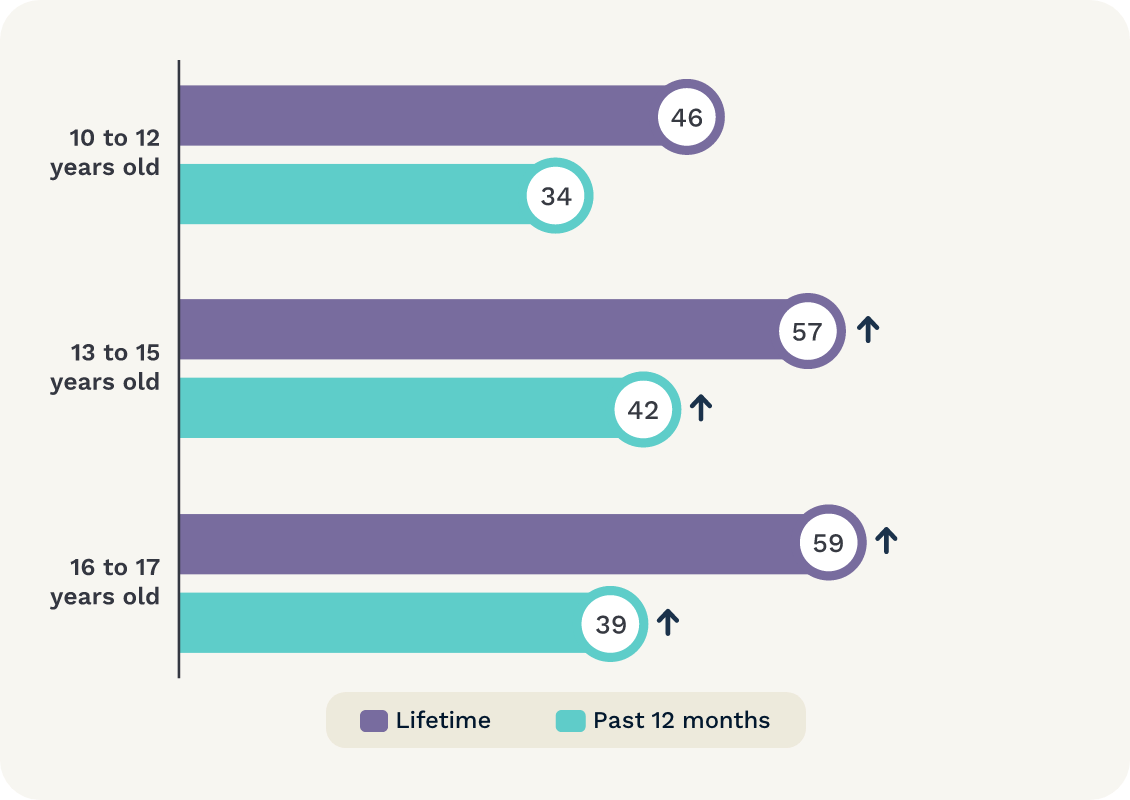
Cyberbullying is more common among teens than younger children
Graph shows prevalence of cyberbullying by child age.7
|
Children are bullied in diverse ways online

38%
had someone say hurtful things to them online.
(23% in the past 12 months).
35%
were purposely left out of an online activity.
(23% in the past 12 months).
25%
had humiliating or hurtful things said about them online.
(14% in the past 12 months).
18%
had humiliating or hurtful lies spread about them online.
(9% in the past 12 months).
17%
had their private messages, information or secrets shared.
(9% in the past 12 months).
16%
were sent or tagged in offensive or upsetting photos or videos.
(9% in the past 12 months).

13%
were told online to hurt or kill themselves, or that they should die.
(7% in the past 12 months).
11%
had humiliating or hurtful photos or videos of them shared online.
(5% in the past 12 months).
11%
had someone say that they were going to hurt or kill them or told other people to hurt or kill them.
(5% in the past 12 months).
8%
had someone share their phone number, email or home address online.
(4% in the past 12 months).
7%
had humiliating or hurtful fake photos or videos made of them and shared online.
(3% in the past 12 months).
7%
had a fake online identity or profile made of them, without their permission.
(4% in the past 12 months).
Most cyberbullying experiences are carried out by peers known in real life

75%
of children said they were most recently cyberbullied8 by someone known in real life,9 most commonly by a friend (62%).10
18% were most recently cyberbullied by someone they didn’t know in real life.
52%
said they were most recently cyberbullied by a teenager (aged 13 to 17).11
38% were most recently cyberbullied by a child (aged 12 or younger) while 4% were most recently cyberbullied by an adult (aged 18 or older).
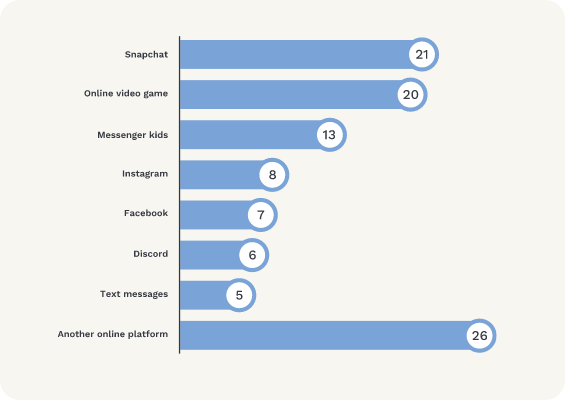
Cyberbullying occurs across a range of online platforms
Children’s most recent experiences of cyberbullying occurred across a range of online platforms12, including Snapchat (21%), online video games (20%), Messenger Kids (13%), Instagram (8%), Facebook (7%), Discord (6%) and text messages (5%).13
|
Children are typically targeted in group chats or direct messages

39%
said their most recent cyberbullying experience occurred on an online group chat, while 27% were targeted in a message, text, email or call from one person.
Cyberbullying also occurred in more visible online spaces – 8% were most recently targeted on comments or posts on someone else’s social media page while 6% were most recently cyberbullied on their own social media page.14
For many children, cyberbullying isn’t a one-off occurrence and can spill over into their offline lives

32%
of children said that the person responsible for their most recent cyberbullying experience had targeted them in the same or a similar way more than once.15
36%
of children who were most recently cyberbullied by someone known in real life, said the person responsible was also doing things like this to them in real life.16
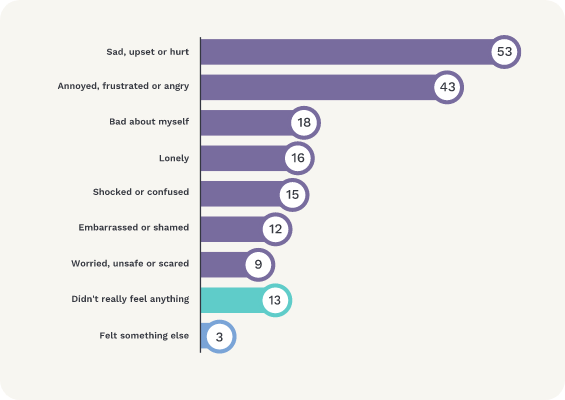
Cyberbullying triggers a range of negative emotions among children

81%
of children reported feeling at least one negative emotion after their most recent cyberbullying experience. Most commonly they felt sad, upset or hurt (53%) or annoyed, frustrated or angry (43%).17
|
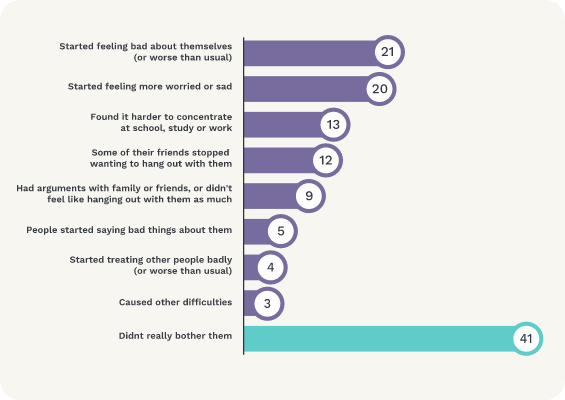
Many children report having difficulties after experiencing cyberbullying

48%
reported at least one difficulty after their most recent cyberbullying experience, most commonly that they started feeling bad about themselves (21%) or more worried or sad (20%).18
|
Helpful resources
eSafety’s Parents section has information for parents and carers, including advice about how to help children if they are being cyberbullied.
eSafety’s Kids and Young People sections also have advice about what to do if someone is being mean to you online and bullying online.
Educators can explore Spotlight on cyberbullying for resources to help develop a whole-school approach to the issue.
Notes
1 Under the legislation, which came into effect on 10 December 2025, age-restricted social media platforms must take reasonable steps to prevent Australian children under 16 from creating or holding accounts.
2 Part of a nationally representative survey of 3,454 children aged 10 to 17 years living in Australia between December 2024 and February 2025.
3 For more information about the methodology of the research, see the methodology report.
4 Sources: G.1.1 and G.1.2 Q: Has anyone online ever done any of the following things to you on purpose because they really wanted to humiliate you or make you feel bad, or make others not like you? Important - answer ‘yes’ to these questions only if you think the person did these things to you on purpose, because they really wanted to humiliate you, or make you feel bad, or make others not like you.
5 The smaller sample size for trans and gender-diverse children should be considered when interpreting these findings (n=83).
6 ‘Sexually diverse’ includes participants who identified their sexual orientation as 'gay or lesbian’, ‘bisexual’, ‘queer’, ‘asexual’, ‘pansexual’ or that they are ‘still working it out’. Sexuality was asked only of children aged 13 to 17.
7 Arrows denote statistically significant differences between sub-groups. The proportion of children aged 13 to 15 and 16 to 17 who had ever or in the past 12 months experienced cyberbullying didn’t differ significantly.
8 A subset of children who had experienced cyberbullying (n=696) were asked further questions about their most recent or impactful experience of cyberbullying.
9 Q: Keep thinking about the last time someone [RECENT EXPERIENCE]. Who did this? You can choose more than one answer.
10 Q: Think now about the last time someone you already knew in real life [RECENT EXPERIENCE]. Who did this? You can choose more than one answer.
11 Q: thinking about the last time someone [RECENT EXPERIENCE]. How old do you think the person who did this was? You can choose more than one answer.
12 Q: Think just about the last time someone [RECENT EXPERIENCE]. Which platform did this happen to you on? You can choose more than one answer.
13 Platforms reported by <5% of children combined as ‘Another online platform’.
14 Q: Keep thinking about the last time someone [RECENT EXPERIENCE]. Where did this happen to you? You can choose more than one answer.
15 Q: When people do hurtful or upsetting things online to others, they may do it once, or they may do it again and again. Keep thinking about the last time someone [RECENT EXPERIENCE]. How many times did the same person do this, or something similar to this, to you online? If you’re not sure, choose the answer that seems about right.
16 Q: The last time someone [RECENT EXPERIENCE], did it only happen online, or was the same person also doing things like this to you in real life?
17 Q: Keep thinking about the last time someone [RECENT EXPERIENCE]. How did you feel? You can choose more than one answer.
18 Q: Keep thinking about the last time someone [RECENT EXPERIENCE]. Did you have any difficulties because of this experience? You can choose more than one answer.
Last updated: 16/06/2026