
Tertiary institutions resources hub

eSafety’s tertiary resources are designed to help create safer online environments for all those studying and working in these organisations.
The resources aim to help tertiary communities be safer online by:
- building greater awareness of online safety risks
- providing guidance on how to prevent, prepare for and respond to online safety incidents
- supporting student and staff wellbeing.
Tertiary Toolkit
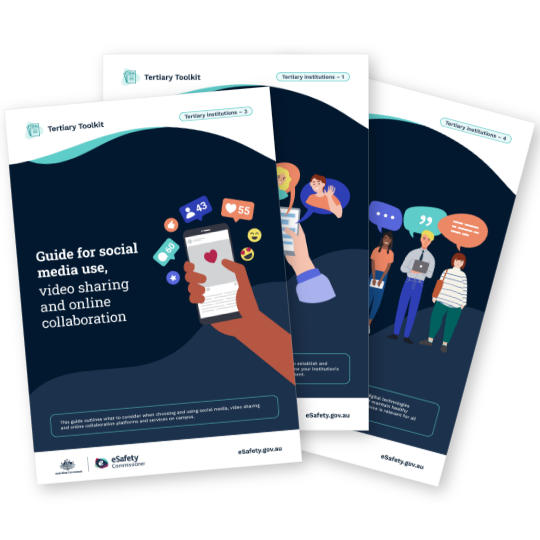
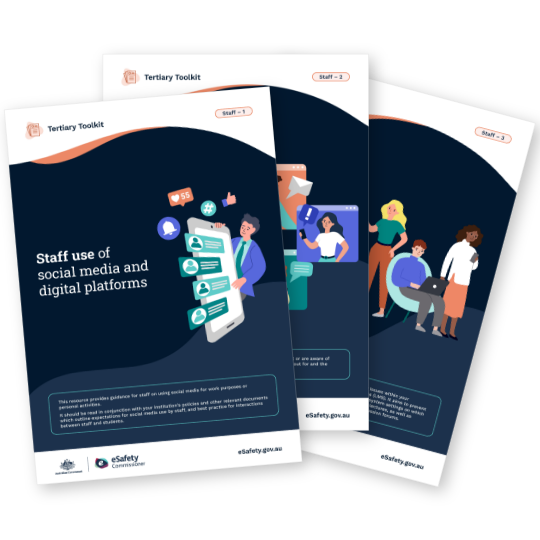
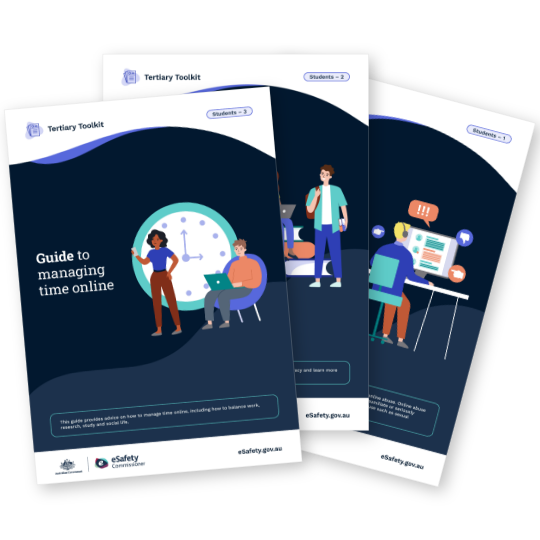
The Tertiary Toolkit contains 12 resources offering targeted advice to three key audiences:
- Tertiary institutions
- Staff
- Students
Downloads
Find individual toolkits for each audience
Subscribe to eSafety news
Stay up-to-date with online issues and receive news about our latest resources, events and research.
The big issues
Help managing key online safety issues impacting your campus.


eSafety 101 for tertiary staff and students
Help staff and students learn key online safety basics, what eSafety does and how to report online harm.
The video includes:
- an overview of online safety and the role eSafety plays in keeping Australians safer online
- information on eSafety’s reporting schemes and the steps required to report online harms and have content removed
- a summary of key eSafety resources with a focus on those most relevant to the tertiary sector.
The video can be used by linking directly to this page or is available on demand for tertiary organisations.
| Audio |
|---|
Welcome to eSafety Commissioner’s professional learning video for tertiary institutions. In this video we will explore what eSafety does and how we support the Australian tertiary sector in keeping their communities safer online. |
You may find some of the issues raised in this video confronting or distressing. If something makes you feel uncomfortable, please take a break or reach out for support. |
eSafety Commissioner or eSafety is Australia’s national online safety regulator, the first one of its kind in the world. Our purpose is to help safeguard Australians at risk from online harms and to promote safer, more positive online experiences. This includes working with the tertiary sector to support staff and students. |
eSafety operates four reporting schemes with the authority to compel online services and platforms to remove serious online abuse, and illegal and restricted online content. A team of skilled investigators work directly with those who are experiencing online harm. |
Our cyberbullying of children scheme is for seriously harmful online communication to or about a child or young person under 18. Through this scheme eSafety can help remove content that is seriously humiliating, seriously harassing, seriously intimidating or seriously threatening. |
Adult cyber abuse is for seriously harmful online communication to or about a person who is 18 or older. Through this scheme, eSafety can help remove content that is menacing, harassing or offensive in all circumstances and intended to cause serious harm. In both cases you must report to the online service first. |
Illegal and restricted content relates to content that shows or encourages the sexual abuse or exploitation of children, terrorist acts or other types of extreme violence, including self-harm or suicide inciting content. If you come across this material, please report to eSafety immediately. |
Image-based abuse is when an intimate image or video is threatened to be shared or is shared, without the consent of the person featured. This includes real or fake images or videos, including deepfakes created by artificial intelligence. Cases of image-based abuse can be reported directly to eSafety. |
Sexual extortion is a form of blackmail with threats to post intimate images or videos unless demands are met, typically for money or more images. Perpetrators of sexual extortion can use fake profiles or may claim to have ‘found’ intimate images. In cases of sexual extortion, eSafety encourages victims to stop all contact with the perpetrator and not give in to any demands. |
Telling someone they trust, such as a friend, family member or colleague can help the victim think clearly, especially if they’re feeling overwhelmed. Blackmailers usually give up when they realise they won’t be paid. But if you do share the intimate image or video online, it can be reported to eSafety and we will help to get it removed. |
eSafety provides support for tertiary institutions in several ways. The Tertiary Hub has a range of support and resources for those studying and working in tertiary institutions. The Hub is also where you will find the Tertiary Toolkit. The Toolkit supports a whole-of-institution approach to online safety and includes resources for management and policy makers, staff, and students. |
There are several other resources on the eSafety website that may be of interest to tertiary students and staff. Support is available for students and staff impacted by technology-facilitated abuse in cases of domestic and family violence. |
Our young people pages include information created with and for young people spanning a range of topics relevant to them. We also have specific resources created to support at-risk communities including First Nations and the LGBTQI+ communities. Plus, information and resources in easy to read and multiple languages. We have a wide range of information and resources for parents and carers, including free webinars. |
If you want to stay up to date with the latest eSafety news, events and resources, you can subscribe to our tertiary newsletter. |
And finally, the eSafety Guide is regularly updated with information on how to protect your personal information and report harmful content on common social media, games, apps and sites. |
That brings us to the end of the video. Thank you for supporting safer online spaces for all tertiary students and staff. |
Video – eSafety 101 for tertiary staff and students
Please contact educationsectors@esafety.gov.au for access to the eSafety 101 video codes to embed on your tertiary institution’s learning management system for internal staff and student use.
Posters and digital signage

Find out more
If you are a tertiary staff member and are interested in learning more about our tertiary-specific resources
Last updated: 12/08/2026