

Helping kids and young people
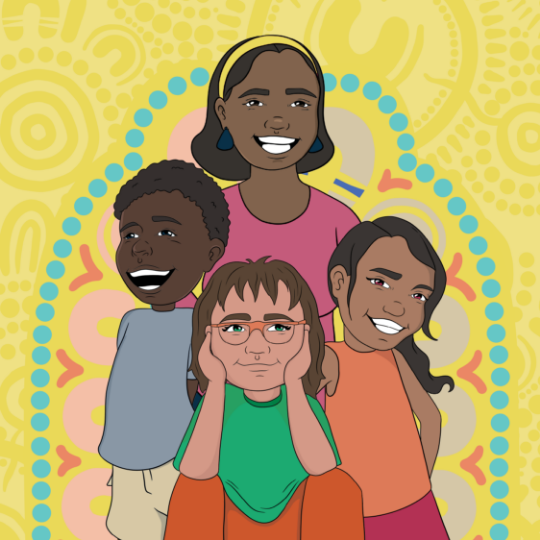
Explore our online safety resources to support First Nations kids and young people.
On this page:
Online safety for everyone
This page has online safety information and resources for everyone who helps grow up our kids and young people – including parents, carers, aunties, uncles, grannies, grandparents, tiddas, balas or cousins.
The guides, fact sheets, yarning cards and videos encourage communities to talk about how to be safe, have fun and learn about online safety together through stories, case studies and activities.
They were developed with the help of First Nations kids and young people, their families and carers, with support from the community of Gimuy (Cairns, Queensland).
There’s also a section focused on Australia’s social media age restrictions for under-16s. Jump straight to it.
Guides and fact sheets
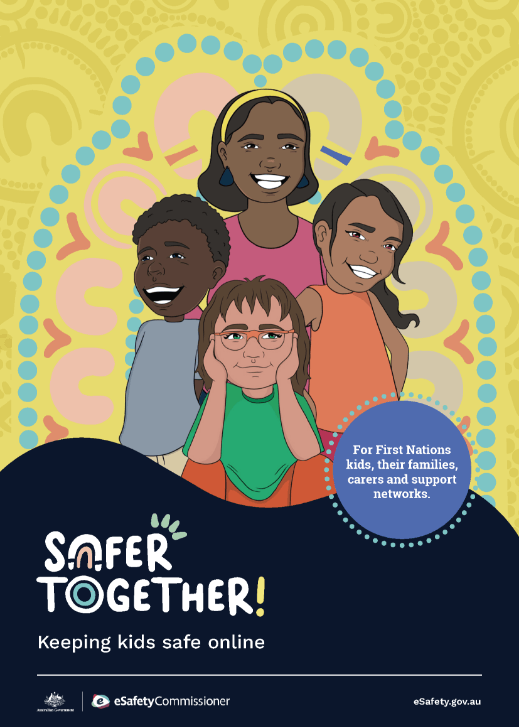
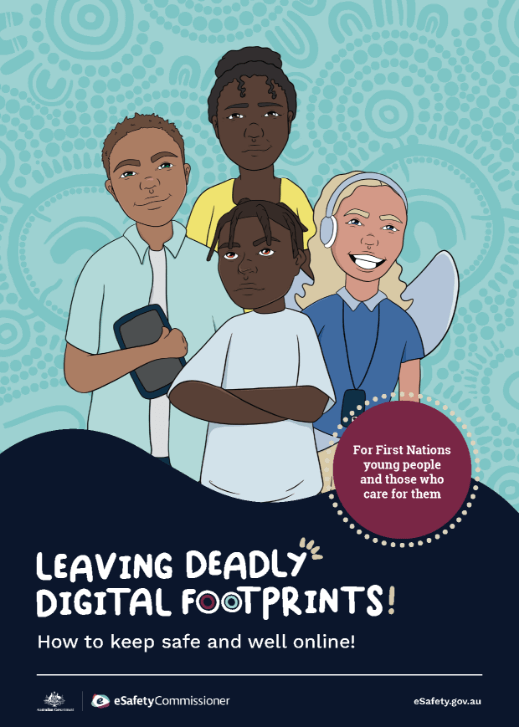
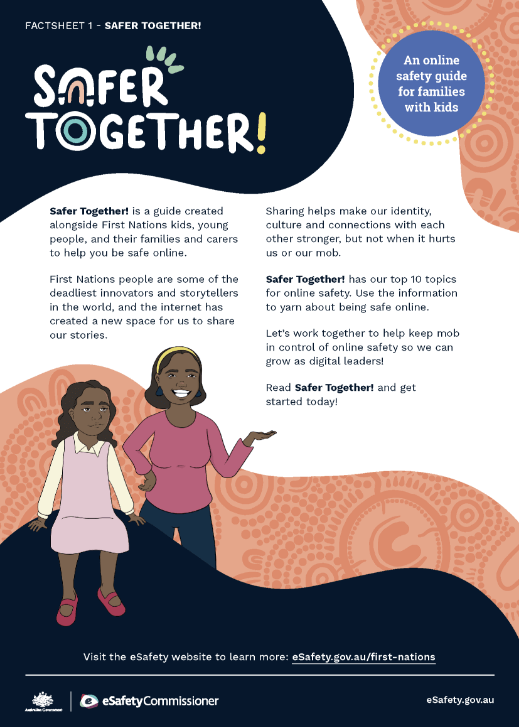
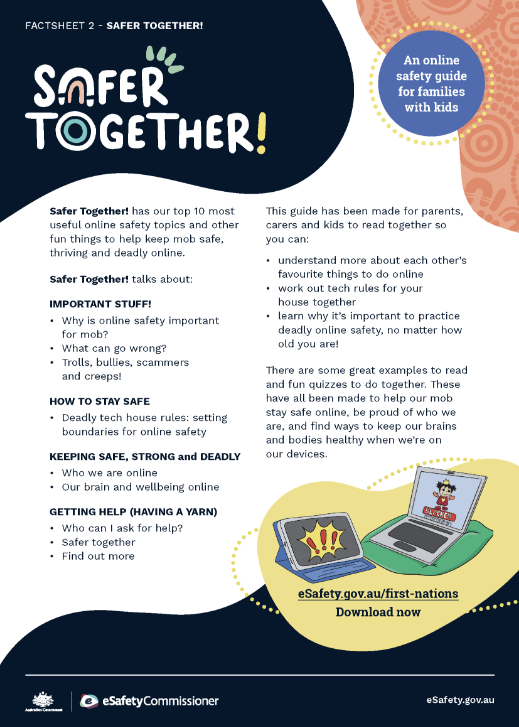
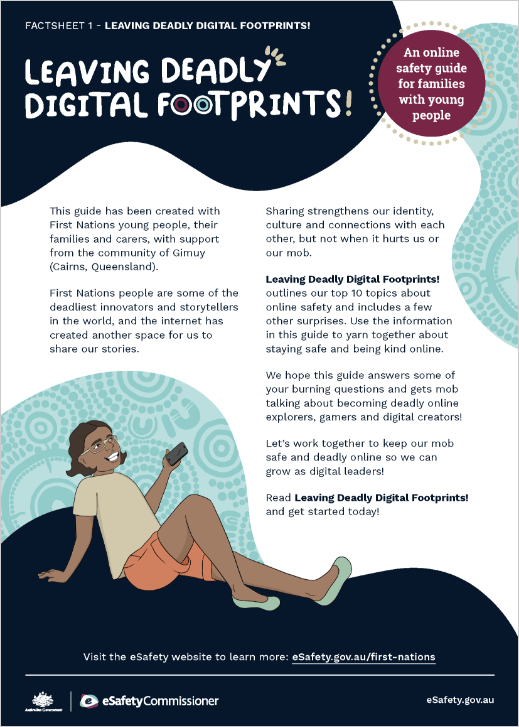
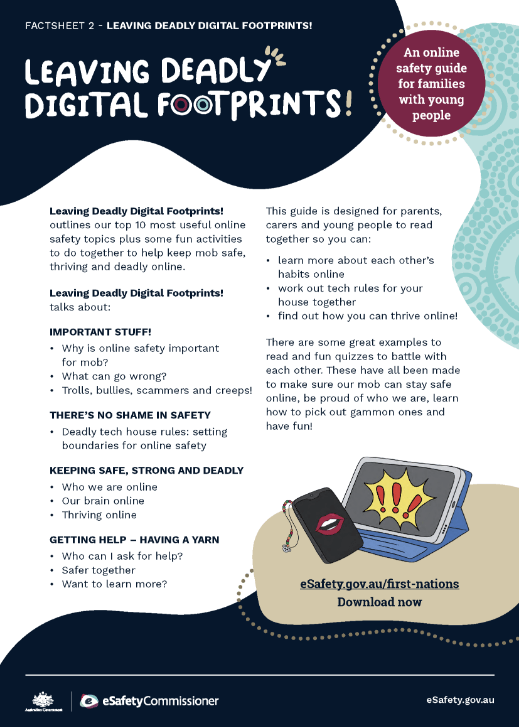
These guides explore our top 10 safety tips including information about creating deadly online habits, what to do if something goes wrong and who to yarn with when families need help. The two-page fact sheets summarise each of the guides.
You can download or print the most suitable guides and factsheets for your kids:
- ‘Safer Together!’ is for families with children from 5 to 12 years old.
- ‘Leaving Deadly Digital Footprints’ is for young teenagers from 13 to 16 years old.
Yarning cards
Talking about online safety is a great way for families to stay connected and support each other when they’re online.
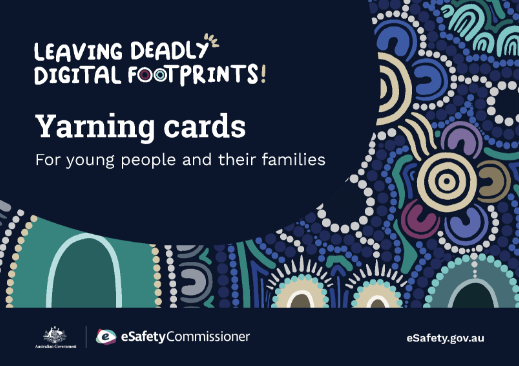
Use these yarning cards to start a conversation. Each card has a different theme and a list of questions you can ask each other to learn together.
Print the cards in the most suitable age range and start your online safety yarn!
Videos
Find out more about what you can learn in 'Safer Together!' and 'Leaving Deadly Digital Footprints.' You can also share these videos to help spread the word.
| Audio |
|---|
My granddad told me that our mob are some of the deadliest storytellers in the world and the oldest. Now the internet lets us share our stories and culture with biggest mobs of people. But sometimes we spend a bit too much time on there or come across gammon people. The Safer Together Guide helps me and my family be safe and deadly online. Check it out.
|
Sharing stories and culture
| Audio |
|---|
Us mob are some of the deadliest storytellers in the world. Being online gives us more ways to share our stories and culture and engage with our mob, but sometimes we spend a bit too much time on there or come across gammon people. The Leaving Deadly Digital Footprints guide helps everyone and our family learn more about online safety. Check it out! |
Leaving deadly digital footprints
| Audio |
|---|
Aunty: Hey bub, let's sit and have a yarn about something. Child: What's up Aunty? Aunty: We are gonna sit and make some rules about what's OK and what's not with being online. Child: Like, what games I can play? Aunty: Yep. Things like that. What times we can be online, how we should act. Nothing bad, just so we have a plan to be safe, yeah? Child: Sweet. |
Family online safety planning
| Audio |
|---|
OK you lot. To the dinner table. Let's go. Why Nan? Have we done something wrong? Nah ma babies. I just want us to make some rules for when you're playing on those phones and things. Oh, OK. You mean like we gotta do our homework first? Yep. Things like that. If we have some good rules, it'll help us all be safe and deadly online. |
Deadly habits to stay safe online
The videos were produced by Saltwater People, with artwork by Desirai Saunders and animation by Ciaran Askew.
Spread the word
Use these resources, including social media tiles, posters and postcards, to help spread the word in your communities.
How do the social media age restrictions affect young people and families?
As of 10 December 2025, many social media platforms are not allowed to let Australians under 16 create or keep an account.
The changes aim to protect under-16s from pressures and risks they can be exposed to while logged in to social media accounts.
Under-16s won't get into trouble if they're still on an age-restricted platform – this is about making the platforms take greater responsibility for the safety of children.
eSafety has developed tools and resources to support young people, as well as parents and carers with this change.
For more details and guidance about the age restrictions, visit the social media age restrictions hub.
Videos for parents
You can watch the Staying Well Connected vodcast, a yarn for First Nations parents and carers about the Social Media Minimum age changes.
There is also a family case study video following Jarin Ingram-Baigent – a Wiradjuri woman, mother, entrepreneur and advocate – and her family as they navigate the changes to the social media landscape together. Their story reflects what so many First Nations families are experiencing right now.
Staying Well Connected vodcast
| Visual | Audio |
|---|---|
[Jaron speaking] “So should we go on the swing today? Do you reckon it's still there?”
|
|
In December 2025, Australia introduced a minimum age of 16 for anyone wanting to have a social media account. |
|
[Jaron speaking] “My name is Jaron Ingram-Baigent. I am a Wiradjuri woman. My family is from Cowra in the central western New South Wales. This is my husband Simon, and we have three children together, Nalani, Clayton, and Malia, and we are the Spences. “The negative ways that we saw social media impacting our kids, probably more anxiety-filled behaviour, almost a resistance to wanting to get off the device. But, if I was going to put it into a nutshell, probably their mental health overall and their overall wellbeing. “And we saw improvements in their wellbeing around those issues the more we talked about this with them.” |
|
[Jaron speaking] “And remember when you, remember when you went on the swing in a white shirt?” [Child 2 speaking] “Oh.” |
|
[Jaron speaking] “So when we first heard about the ban, I would say it sparked a bit of a conversation, and we did go through a lot what the pros and what the cons might be. Wasn't quite sure how to feel about it. “We definitely saw the benefits and what the positives would be. But also we understood that there were gonna be some negative or potential negative implications that we'd have to talk the kids through, and that it would be a process.” |
|
[Simon speaking] “Yes, I was supportive. I do know that less screen time, their behaviour will be better. Less social media means we have to engage with the kids more Which is a good thing, it brings back a better bond to the children." |
|
[Child 1 speaking] “When I first heard about the social media ban, I was a bit, like, annoyed and scared and worried that I wouldn't be able to keep in contact with, like, most of my friends. But now I've, like, changed to other apps and it's not as hard.” |
|
[Child 2 speaking] “Since coming off social media... the change has been quite different, but I think it has helped some people but also debuff. Like, it can be harder to communicate, but a lot more better, you know? “I've more time to, like, go outside, you know? To really think about, like, stuff and really focus, you know? I might have, like, work to do, so the ban has, have, like, helped, not just, like, mid-working pull up and just start watching videos or movies, you know?” |
|
[Simon speaking] “Well, so since the ban, we've noticed that there's more kids at our house. So, kids from the neighbourhood. They're all on their out on mountain bikes, and we'll come home... we'll see bikes sprawled out on the lawn. “It's good to see. It's like the old days. And, yeah, we walk in and it's kind of a good feeling knowing that there's gonna be a heap of kids just here.” |
|
[Jaron speaking] “Definitely the hardest part of this transition has been managing it. Um, there's still ways that young people can access it without an account, and that has been really tricky for us to try and navigate with the kids. Ultimately, it's gonna need their cooperation and their buy-in and their understanding, and so working through what that means for them is a process. We're still working through that with our kids. “The things that we've done to support them is just to make sure that there's consistency in all of their interests and their activities. They've been dancing with Brolga for a number of years now, so they're deeply committed to their dance and also pursuing their own interests in various ways.” |
|
[Child 2 speaking] “Well, I love, like, learning new dances, seeing what they mean, meeting new people, teaching, like, other people moves, you know? Like the culture and the depth and the meanings. “Yeah. Yeah, when I go there, I feel like more connected to, like, Mother Nature. By me, like, you know, our ancestors. It just makes me feel like that's the place you go when you wanna, like, you know, feel very connected.” |
|
[Simon speaking] “So since the ban, we, we got our daughter, who's 14, a gym membership. I'm going with her there. So that's probably my favourite sort of father-daughter activity. Also we got our boy a mountain bike, and, I've been out with him on that, so it's good.” |
|
[Jaron speaking] “I'm gonna make more of these, like, with the little stringy bits. Are they gonna be big earrings?” [Child 1 speaking] “I'm not sure. I might do one or two more layers.” |
|
[Jaron speaking] “I think the one thing that I hope that this gives the kids back is just a bit of time. Bit of time to, be kids enjoying their surroundings by looking up a little bit and, you know, they're always gonna be on technology and devices, and I think that's a wonderful thing. “But I also think it's equally, if not more, it is more important to look up and connect to country and community and family. Um, and that's where I see the greatest benefit.” |
|
You don’t have to have all the answers. You just have to start the conversation. |
A First Nations family navigating the social media changes
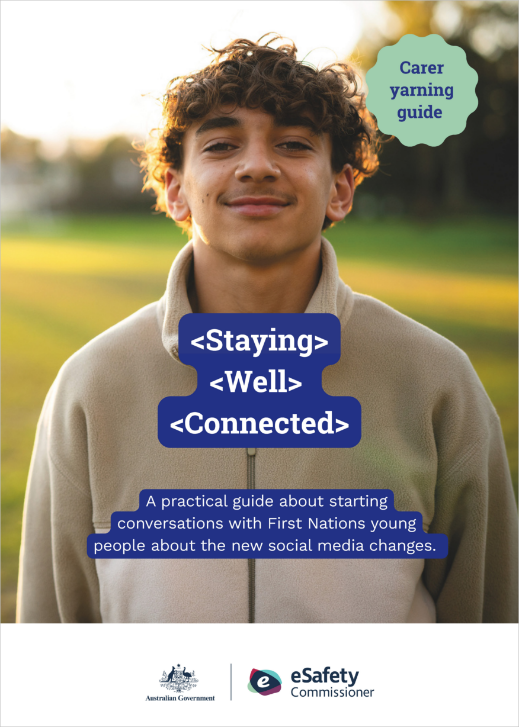
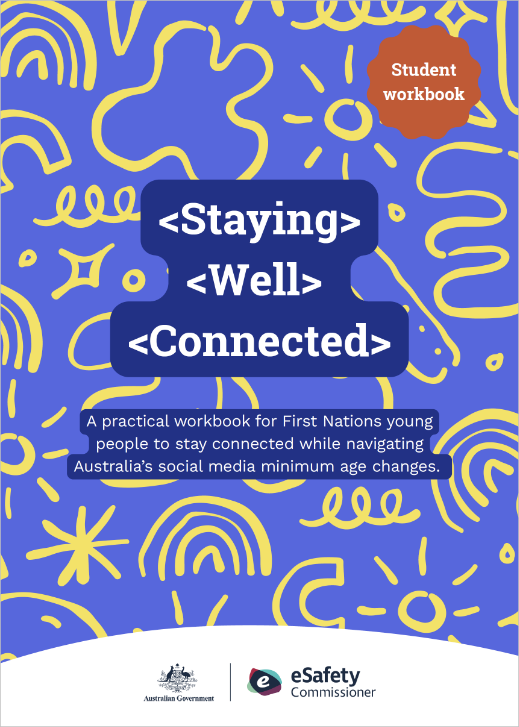
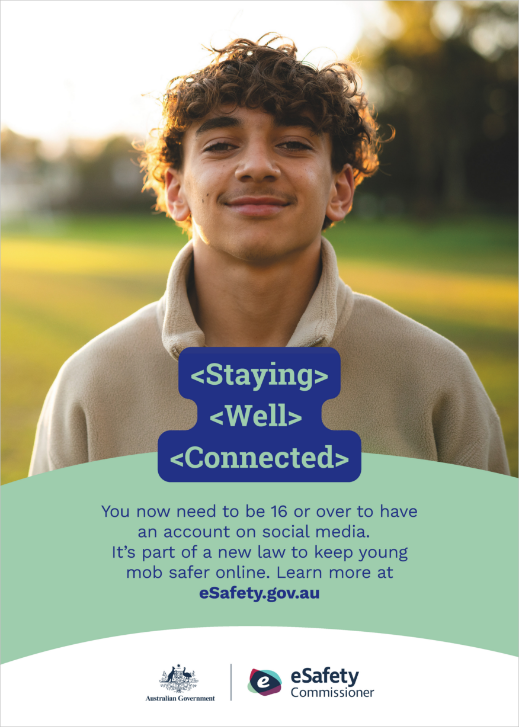
Parent/carer yarning guide, student workbook and poster/A5 flyer, digital toolkit
You can also download or print:
- a yarning guide to help parents and carers to start conversations with First Nations young people about the social media age restrictions
- a workbook to help First Nations young people stay connected while navigating this change
- flyers/A5 posters to share the message about the social media age restrictions with your organisation or community
- a digital toolkit with ready-to-use information for First Nations stakeholders.
More resources
You can also use these resources to help kids and young people make good choices online.
| Audio |
|---|
You wouldn't invite a stranger into your home or bedroom, right? But that's what's really happening if someone you don't know contacts you online, which happens to one in four young people like me. There's no way of telling if the person is who they say they are. So if they ask you for favours, say they like your body or your appearance, ask personal things, want photos of you or want to meet you? Tell someone straight away. You can also stop responding to them, block and report them and make your accounts private. The eSafety Guide has tips on how to do this. But most importantly, if you think something's not right, trust your instincts and tell people straight away. Because staying safe means staying safe online too. For more information on how to stay safe online, visit esafety.gov.au. Funding for this project has provided through the eSafety Online Safety Grants program, an Australian Government initiative. |
Dealing with strangers online
| Audio |
|---|
Young boy: Hey, Dad. Mind if I head off to that party and hang out with those guys. Dad: We all have rules to help keep our kids safe at home and in the Community, right? So it should be the same when they have a smartphone. We need to set up some clear boundaries to keep them safe. Here’s some that you and your kids might want to agree on. No phones after a certain time and keep it to a daily screen time limit, like one hour on school nights. No sharing their passwords with others or sharing their real name, age and address when posting, talking to strangers or on sites where anyone can see it. Be kind to people and don't take or share photos of others without their permission. And remember, you can use technology tools to help set the boundaries to keep your child safe, like using parental controls to help manage their privacy and the types of content they can access, because having some rules to keep our kids safe means rules for using their phones too. |
For more information on how to stay safe online, visit esafety.gov.au. Funding for this project was provided through the eSafety Online Safety Grants program, an Australian Government initiative. |
Setting online boundaries
These videos were developed by Queensland Remote Aboriginal Media (QRAM) and funded by the eSafety Online Safety Grants Program. Watch more on our page about online hate and abuse.
Find out more about cyberbullying and how you can help young mob to deal with it.
| Audio |
|---|
Let's go on a journey. A long time ago in the Dreaming, stories were formed and told the old way, person to person. These stories have left footprints for generations to follow. These days, technology has changed the way we share and tell our stories. [Reads title] Digital Footprint, Online Business is Everyone's Business. As soon as we go online our digital footprint begins. |
How we look after our digital footprint will impact on how our future generations will understand and see our culture. What you text and post goes further than your own mob's Country. So it's real important that we build a strong digital footprint by being deadly in everything we say and do online. |
Texting and using social networking sites shapes how people see you now and into the future. A bad digital footprint can damage friendships, break relationships, hurt job chances and bring shame to your mob. It can lead to payback and violence between families and community. |
All right you mob, I want you to go out there and be the best you can be. You’re in control of what you do online. You kids are our future. And I know you can do the right thing by looking after your mates, respecting our culture and being positive when you go online. |
You want to build a strong digital footprint. Bring some pride to you and your mob by being respectful when you're online. Remember online business is everyone's business. What you post today can come right back to your mob like boomerang. |
Under 25? Worried about your digital footprint? You can make a free call to Kids Helpline on 1800 55 1800. |
Video: Digital footprint
| Audio |
|---|
Let's go on a journey. Long time ago in the Dreaming, stories were formed and told the old way, person to person. These stories have left footprints for generations to follow. These days, technology has changed the way we share and tell our stories. |
[Reads title] Bullying online, shame long time. Cyberbullying is bullying using phones and online sites. It can happen to anyone and can leave you feeling unsafe and feeling shame. Cyberbullying can make you feel alone, outside your friends, family and the mob. It can split families and communities, and sometime can lead to payback and violence. |
What does it look like? Abusive texts and emails, threats, posting nasty comments, photos and gossip, pretending to be someone else online to stir trouble or bring shame, leaving people out online, blackmail, hate pages. How do you deal with it? Don't fight back. No matter how much you want to, as soon as you fight back online, it makes it worse and leaves a bad footprint for you. Don't post abusive messages. It can get you in trouble with the law. You can block the person who's doing the bullying. Change your privacy settings. Report it and collect the evidence. Keep mobile phone messages, emails and online posts. Talk to someone you trust. |
If you see or know about cyberbullying going on, there are things you can do. Support the person being bullied. Ask them if they're OK. Don't forward on messages or pictures if you see them. Stand up and speak out. Keep the messages to show a trusted adult or a leader in the community what's going on. Report and block the bully. This can be done online and is anonymous. |
Under 25? Worried about cyberbullying? You can make a free call to the Kids Helpline on 1800 55 1800. |
Video: Bullying online. Shame longtime.
These videos are part of the Be Deadly Online series in Classroom resources.
You can find more topics and videos in this series about how to stay safe online.
Stay up to date
Sign up for regular online safety advice to help you support your First Nations community.
Last updated: 20/08/2026


