

Smart glasses and online safety: When the camera disappears
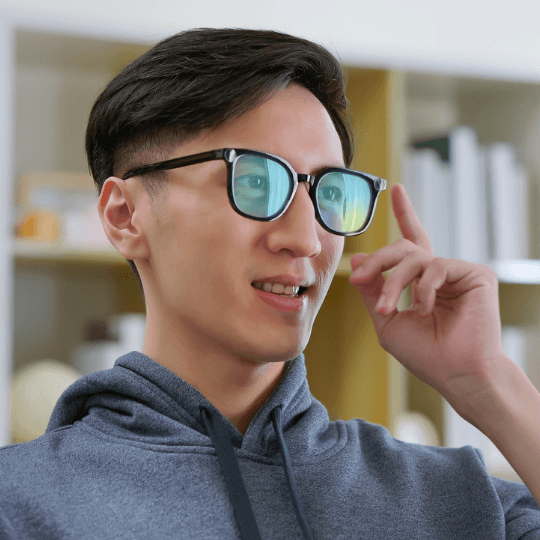
This edition of our Tech Trends Converge series is part of our broader work on immersive technologies. It explores how covert recording enabled by smart glasses has the potential to amplify harmful content and conduct online, including image-based abuse, adult cyber abuse, cyberbullying of children and exposure to violent material.
It also considers the role of eSafety, industry and the broader digital ecosystem in reducing the harms associated with immersive technologies.
On this page:
- What are smart glasses?
- The intersection of discreet design and accessibility
- Unpacking the harm: covert recording
- Future harms
- Safety by Design for smart glasses
- Ensuring the safe use of smart glasses
- Resources
- Notes and references
This page was first published in August 2026.
What are smart glasses?
Smart glasses are a type of immersive technology worn as eyewear that contains a small computer. Examples include products such as Meta smart glasses, Rokid glasses, and other smart eyewear devices. Most models currently available are designed to look like regular glasses or sunglasses, and many technology companies collaborate with fashion brands and influencers.1 Advances in technology and the shift towards more fashionable designs have helped create a market for these immersive products.2
Because modern smart glasses are relatively new, there is not yet strong consensus about the features users expect them to have. Current models often include cameras, microphones and AI capabilities such as automatic translation and online search. Some also have displays built into the lenses that provide information and notifications. This range of features offers benefits but can also create safety risks through product design.3
Smart glasses are often marketed as alternatives or additions to smartphones, giving users easier access to functions such as capturing point-of-view content, real-time language translation and hands-free access to information.
Although smart glasses offer many of the same capabilities as smartphones, they pose new safety challenges because they remove visible cues that someone is recording,4 such as holding up a phone. A user needs only to look at what they want to record, making it difficult for bystanders to know they are being filmed. Limited safety features, such as small recording lights, can be easily missed,5 covered6 or disabled7 by users who intend to cause harm.
The intersection of discreet design and accessibility
Smart glasses are beginning to make a meaningful difference as accessibility devices for people with disability.8 For example, people who are blind or have low vision can use smart glasses to look at an object and ask for a description.9 Deaf users may also benefit from features such as live speech-to-text when communicating with someone who does not understand sign language.10
Smart glasses can also benefit people with disability because they do not immediately look like an accessibility device.11 Visible accessibility devices can expose users to discrimination and stigma.12 At the same time, many disability activists criticise a culture that pressures people to hide or conceal their disability, highlighting the need for cultural change rather than tools designed to make a person with disability appear as if they do not live with disability.13
For those who choose to use them, smart glasses can help avoid disclosing a disability in situations where this may lead to discrimination or stigma. However, their use should not undermine efforts to reduce stigma and discrimination associated with visible disabilities and accessibility devices.
The accessibility benefits of smart glasses are important and should be acknowledged and celebrated. These benefits do not inherently conflict with safety features. Although technology companies may pit accessibility benefits against safety and privacy considerations,14 smart glasses can deliver meaningful accessibility improvements while also prioritising user safety.
Failing to address safety risks can also undermine accessibility. Unsafe design features have already prompted backlash15 and distrust,16 which may increase negative sentiment towards people who use smart glasses,17 including people with disabilities.
Unpacking the harm: covert recording
To address current safety concerns, many technology companies place responsibility on users to use smart glasses safely.18 However, asking people to use a product responsibly is not an adequate safety policy. It also overlooks how smart glasses are actually used in practice. In a 2024 study of Australian adults, 17% of smart glasses owners reported using them in a prohibited way, such as recording others without consent or recording in restricted locations.19
The harms linked to covert recording are not hypothetical. They are real and already occurring. People are using smart glasses to covertly record content for social media. Some of this content may seem harmless. For example, ‘joybait’ influencers film themselves performing random acts of kindness for unsuspecting strangers who do not know they are being recorded.20
Even when these videos seem innocuous, recording people without their knowledge denies them the ability to consent to being recorded and appearing in social media content, as well as agency and control over how their image is used.
Harms associated with smart glasses go beyond being recorded without consent. ‘Pick up artist’ content creators use smart glasses to film themselves flirting with women and asking them on dates, then upload the footage to social media under the guise of providing ‘dating advice’.21 Most of the women do not realise they are being filmed. These posts often attract misogynistic comments, compounding the harm.22
Used in this way, smart glasses can reinforce and normalise watching, recording and controlling women in public without their knowledge. This contributes to harmful gendered stereotypes and undermines women’s agency in public spaces.23
Other creators use smart glasses to film ‘prank’ content that often involves harassing service workers through bizarre, antisocial or discriminatory behaviour.24 As with pickup artist content, the comment sections of these videos can attract further harmful comments. In some cases, perpetrators have demanded money from victims to remove viral content recorded using smart glasses,25 extending existing forms of online extortion.
Smart glasses may also be used to perpetrate image-based abuse. Image-based abuse26 occurs when someone shares, or threatens to share, an intimate image or video27 of a person without their consent. The same covert recording features used to create prank, pickup artist and joybait content could also be used to perpetrate image-based abuse in private settings.28
Non-consensual recording of members of the public has long been a problem, and the widespread availability of smartphones has exacerbated the issue. Smart glasses can make this recording almost undetectable, further exacerbating and amplifying harm.
Future harms
As smart glasses evolve and become more common, they may become increasingly interconnected with and create new ways to perpetrate different types of harms, such as image-based abuse, adult cyber abuse, cyberbullying of children, or the livestreaming of violent or other harmful content. There are growing concerns they could be used to livestream violent or harmful content on social media platforms. Because smart glasses are hands-free and allow livestreaming, they make it easier to broadcast all types of content, including violent material.29 Once shared, a livestream can spread rapidly and become increasingly difficult to remove.
Some companies are also considering integrating facial recognition into smart glasses,30 raising serious safety and privacy concerns. For example, more than 64 civil society organisations have written an open letter to Meta, a prominent seller of smart glasses, warning that planned facial recognition features could amplify these harms.31
Although Meta has reportedly removed facial recognition code from its products,32 researchers have been able to add facial recognition technology to automatically identify strangers and retrieve personal information, including home addresses, phone numbers and details about family members.33 This can happen without the person’s knowledge or consent.
Combined with images captured by smart glasses, this information could be used to create deepfakes34 or contribute to offline harms such as stalking or doxing.35
As smart glasses become more common, they may create new ways to perpetrate harms. Developers have a critical opportunity to embed safer design practices and reduce risks before the technology becomes ubiquitous, avoiding more costly retrofits later.
The design and features of smart glasses are still evolving. This creates an opportunity to make sure safety is built in early, before unsafe features become entrenched and the harm is widespread.
Safety by Design for smart glasses
Companies selling smart glasses must balance the benefits of the technology with the need to protect users and the public. A coordinated and holistic approach is necessary to address the potential for smart glasses to amplify existing harms.
eSafety’s Safety by Design initiative encourages technology companies to proactively embed user safety from the outset and invest in risk mitigation throughout the design, development and deployment lifecycle. Safety by Design has three pillars that support user safety across digital platforms and services: service provider responsibility, user empowerment and autonomy, and transparency and accountability.
As the design and key features of smart glasses are still evolving, companies have an opportunity to embed Safety by Design principles now, at the core of their products.
These are some critical steps companies can take:
- Clear visual indicators when recording audio or video: Some smart glasses already use lights to indicate they are recording. However, bystanders often do not notice these lights, particularly if they are unfamiliar with the technology.36 Smart glasses need a clear and unmistakeable recording indicator that cannot be disabled or easily obscured. If the light is tampered with, recording functions should be blocked.
- Limits on information retrieval: Companies need to place clear safeguards around the information users can retrieve. Users should not be able to use smart glasses to obtain information about members of the public.
- Automatic blurring of people’s faces: Companies should automatically blur the faces of people who have not provided informed consent. This would help prevent people from being filmed without their knowledge in ways that could later cause harm.
- Disabling recording when smart glasses are not being worn: Companies should ensure that smart glasses do not have the functionality to record when they are not being worn. This would reduce the risk of covert recording when the user is not physically present.
- Delays and moderation for livestreaming: Livestreaming from smart glasses should operate on a delay and include visual and audio indicators when streaming begins. The delays should allow moderation software to review content before it is broadcast.37
eSafety’s Online Safety Codes and Standards (Unlawful Material) were developed to address the most harmful online content, such as child sexual exploitation material and pro-terror material. Service providers have a range of mandatory obligations, such as to prevent, detect and remove unlawful material, which may include, for example, content captured and shared via smart glasses.38
eSafety can investigate a service provider’s compliance with the relevant Online Safety Codes and Standards and take a range of enforcement actions in cases of non-compliance, including civil penalties of up to A$54.6m. Obligations under the Equipment Code include giving users information about online safety tools and features, as well as their right to make complaints about unlawful material encountered on a service.
Ensuring the safe use of smart glasses
With the smart glasses market still taking shape, manufactures and consumers will develop clearer expectations about their features and hardware design. If we do not act now to prevent design elements from being weaponised to cause harm, we risk unsafe features becoming entrenched. Safety by Design principles must remain at the forefront of design, development and deployment of smart glasses.
Looking ahead, we can expect more sophisticated forms of harm as smart glasses are combined with other technologies such as facial recognition, image recognition and generative AI. With foresight and coordinated action, we can shape a safer digital world where innovation and responsibility go hand in hand.
Smart glasses offer significant opportunities for many people, particularly people with disability. However, these benefits will not be fully realised unless the potential misuse of the technology is addressed through its design.
With collaboration, transparency and accountability, and by embedding safety into every layer of the digital ecosystem, we can support the benefits of smart glasses, including benefits yet to emerge, without compromising safety.
Now is the time to make sure the design of smart glasses responds effectively to emerging risks and harms.
Resources
If you are experiencing online harm or abuse, with or without smart glasses, you can make a report to eSafety.
You can also speak to a mental health professional from an expert counselling and support service.
Learn more about image-based abuse, adult cyber abuse and cyberbullying of children, including how to get help.
Explore our Safety by Design resources.
Notes and references
1 Business of Fashion, Smart glasses are ready for a breakthrough year, 2026, https://www.businessoffashion.com/articles/technology/the-state-of-fashion-2026-report-smart-glasses-ai-wearables/ ; T Pero, The Guardian, Smart glasses are deeply creepy. Why are celebrities like Kylie Jenner endorsing them?, 2026 https://www.theguardian.com/commentisfree/2026/jul/17/ai-meta-smart-glasses
2 A Neely, Apple Insider, Sergey Brin through he had his Steve Jobs moment with the failed Google Glass, 2025, https://appleinsider.com/articles/25/12/26/sergey-brin-thought-he-had-his-steve-jobs-moment-with-the-failed-google-glass
3 J Pero, Gizmodo, Nobody seems to agree on smart glasses, 2025, https://gizmodo.com/nobody-seems-to-agree-on-smart-glasses-2000695082
4 M Stilinovic, ABC, Why smart glasses are the Trojan horse of unbridled digital harm, 2026, https://www.abc.net.au/religion/smart-glasses-are-the-trojan-horse-of-unbridled-digital-harm/106596650
5 E Hunt, Guardian, I wore Meta’s smart glasses for a month – and it left me feeling like a creep, 2026, https://www.theguardian.com/technology/2026/apr/01/i-wore-metas-smartglasses-for-a-month-and-it-left-me-feeling-like-a-creep
6 R Rogers, B Ashworth, Wired, TikTok promotes stickers for secretly recording Meta Ray Ban video, 2025, https://www.wired.com/story/tiktok-promotes-stickers-for-secretly-recording-meta-ray-ban-video/; R Stanton et al, ABC, Seeing like Meta: Smart glasses and the ethics of augmented reality, 2025, https://www.abc.net.au/religion/meta-ai-smart-glasses-and-the-ethics-of-augmented-reality/105849612
7 J Cox, J Koebler, 404 Media, A $60 mod to Meta’s Ray-Bans disables its privacy protecting recording light, 2025, https://www.404media.co/how-to-disable-meta-rayban-led-light/; R Stanton et al, ABC, Seeing like Meta: Smart glasses and the ethics of augmented reality, 2025, https://www.abc.net.au/religion/meta-ai-smart-glasses-and-the-ethics-of-augmented-reality/105849612
8 In this piece, we use person-centred language. However, we acknowledge that there are a range of terms that people with lived and living experience may identify with and that these terms evolve over time. We celebrate the diversity of all voices and experiences.
9 R Samadder, Guardian, Chris McCausland: Seeing into the Future – an astonishing look at how tech is changing disabled people’s lives, 2025, https://www.theguardian.com/tv-and-radio/2025/nov/22/chris-mccausland-seeing-into-the-future-tech-changing-disabled-peoples-lives-bbc
10 C Sygrove, Hearing Tracker, Hear with your eyes: A review of live captioning glasses, 2026, https://www.hearingtracker.com/hearing-glasses/hear-with-your-eyes-five-ar-live-captioning-glasses
11 G Velasquez, Ability Magazine, Meta Ray-Bans: Blind User’s experience with smart glasses, 2025, https://abilitymagazine.com/meta-ray-bans-blind-users-experience-with-smart-glasses/
12 S Koppakula, 3DA, The stigmas surrounding assistive technology, nd, https://www.3da.org/post/the-stigmas-surrounding-assistive-technology
13 J Johnson and K Kennedy, Introduction: Disability in/visibility, and risk, Rhetoric Society Quarterly, 50(3), 2020, https://www.tandfonline.com/doi/full/10.1080/02773945.2020.1752126
14 Access Advisors, Meta glasses and the privacy debate, 2026, https://accessadvisors.nz/blog/meta-glasses-and-the-privacy-debate
15 S Gecsoyler, The Guardian, ‘I’ve definitely lost followers’: influencers face backlash over Meta ‘pervert glasses’ content, 2026, https://www.theguardian.com/technology/2026/aug/09/i-kept-catching-people-giving-me-dirty-looks-the-backlash-against-meta-smart-glasses; M Klee, Wired, The rise of the Ray-Ban Meta creep, 2026, https://www.wired.com/story/the-rise-of-the-ray-ban-meta-creep/
16 A Neely, Apple Insider, Why camera-equipped smart glasses are already a privacy disaster, 2025, https://appleinsider.com/articles/25/11/07/why-camera-equipped-smart-glasses-are-already-a-privacy-disaster
17 K Bell, Engaget, The Meta glasses backlash is changing how (or if) people use them, 2026, https://www.engadget.com/2212604/the-meta-glasses-backlash-is-changing-how-or-if-people-use-them/; V Song, Verge, All these smart glasses and nothing to do, 2026, https://www.theverge.com/tech/921159/smart-glasses-review-wearable-even-realities-g2-meta-ray-ban-rokid-lucyd-oakley-meta-vanguard
18 Meta, Designed for privacy, controlled by you, nd, https://www.meta.com/au/ai-glasses/privacy/?srsltid=AfmBOooHWgVTfZn9ZFtNJMp3OjnHraoxtL4U7SKBc9MKR0U6VxR0VAeZ
19 F Kaviani et al, Exploring social perceptions of everyday smartglass use in Australia, 2024, https://pubmed.ncbi.nlm.nih.gov/39485765/
20 C Townsend, Mashable, Pranksters and pickup artists are using Meta Ray-Ban glasses to harass strangers for content, 2026, https://mashable.com/article/meta-ray-ban-glasses-are-making-it-easier-to-film-strangers-for-content
21 S Tanno and I Scatola, CNN, So-called ‘manfluencers’ are filming themselves trying to pick up women. Smart glasses are their perfect tool, 2026, https://edition.cnn.com/2026/02/09/world/manfluencers-smart-glasses-intl
22 S Tanno and I Scatola, CNN, So-called ‘manfluencers’ are filming themselves trying to pick up women. Smart glasses are their perfect tool, 2026, https://edition.cnn.com/2026/02/09/world/manfluencers-smart-glasses-intl
23 S Tanno and I Scatola, CNN, So-called ‘manfluencers’ are filming themselves trying to pick up women. Smart glasses are their perfect tool, 2026, https://edition.cnn.com/2026/02/09/world/manfluencers-smart-glasses-intl
24 F Landymore, Futurism, The worst people alive are obsessed with Meta’s video recording classes, 2026, https://futurism.com/artificial-intelligence/meta-glasses-fans
25 F Landymore, Futurism, Man wearing smart glasses secretly records woman, demands money to delete video from his socials, 2026, https://futurism.com/future-society/man-smart-glasses-records-woman-demands-money
26 eSafety, Image-based abuse, /key-topics/image-based-abuse eSafety can help remove content if material meets the thresholds set out in the Online Safety Act 2021 (Cth).
27 An image or video can be considered ‘intimate’ if it shows or appears to show an individual nude or partly naked, their genitals or bottom, doing a private activity such as using the toilet or showering, or without clothing of religious or cultural significance.
28 eSafety, Report image-based abuse, /key-topics/image-based-abuse/report-image-based-abuse.
29 J Abrams, Tech Policy Press, Considering the risks of AI-enabled ‘smart glasses’ in livestreamed violence, 2025, https://www.techpolicy.press/considering-the-risks-of-aienabled-smart-glasses-in-livestreamed-violence/
30 L Bernardone, Information Age, Meta eyes facial recognition for smart glasses, 2026, https://ia.acs.org.au/article/2026/meta-eyes-facial-recognition-for-smart-glasses.html
31 Consumer Federation of America, Meta Rayban Letter, 2026, https://consumerfed.org/meta-rayban-letter/
32 D Mehrotra and D Cameron, Wired, Meta deletes face-recogition system from its smart glasses app after WIRED report, 2026, https://www.wired.com/story/meta-removes-face-recognition-code-meta-ai-app-smart-glasses/
33 J Cox, 404Media, Someone put facial recognition tech onto Meta’s smart glasses to instantly dox strangers, 2024, https://www.404media.co/someone-put-facial-recognition-tech-onto-metas-smart-glasses-to-instantly-dox-strangers/
34 A deepfake is a digital photo, video or sound file of a real person that has been created with AI (artificial intelligence) to make an extremely realistic but false depiction of them doing or saying something that they did not actually do or say. Deepfakes are created using AI software that draws on real photos or recordings of the person to model and produce new content.
35 Doxing (or doxxing) is the intentional online exposure of an individual’s identity, private information or personal details without their consent with the intent of causing harm.
36 E Hunt, The Guardian, I wore Meta’s smartglasses for a month – and it left me feeling like a creep, 2026, https://www.theguardian.com/technology/2026/apr/01/i-wore-metas-smartglasses-for-a-month-and-it-left-me-feeling-like-a-creep
37 J Abrams, Tech Policy Press, Considering the risks of AI-enabled ‘smart glasses’ in livestreamed violence, 2025, https://www.techpolicy.press/considering-the-risks-of-aienabled-smart-glasses-in-livestreamed-violence/
38 The Online Safety Equipment Code (Unlawful Material) applies to manufacturers and suppliers of equipment such as smart glasses, as well as maintenance and installation providers, and operating system providers.
Last updated: 01/09/2026