

Social media age restrictions evaluation: Methodology report
This report describes the design of the outcome evaluation for the Social Media Minimum Age law, that is being led by eSafety in collaboration with our Lead Academic Partner, Stanford University’s Social Media Lab, and our Academic Advisory Group.
This report provides a high-level overview of the evaluation approach, study design, data collection and analysis methods, ethical considerations, governance arrangements, and the strengths and limitations of the evaluation design.
This report is complemented by the Social Research Centre’s technical reports, and the Study Protocol paper published on the Open Science Framework, which describe the evaluation methodology in greater detail.
Updated methodology reports will be published as needed as the methodology develops over time.
Download the methodology report
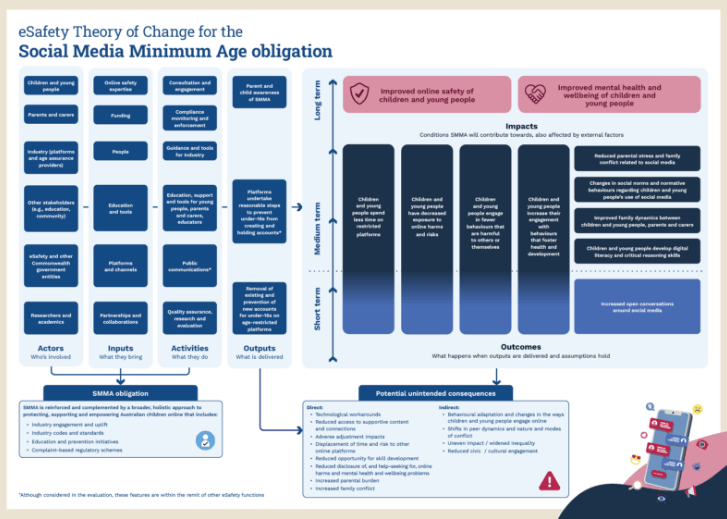
Download the Theory of Change
A ‘Theory of Change’ sets out how and why a policy is expected to lead to impacts. It identifies key activities, outputs, and assumptions, which may contribute to intended and potential unintended outcomes, and external factors influencing implementation. In this way, it can be seen as a ‘change pathway’.
The Theory of Change underpins the SMMA evaluation.
Last updated: 31/07/2026